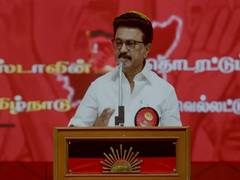
Tamil Nadu: Tamilaga Vettri Kazhagam Chief and Actor Vijay opposes CAA notification
"In the circumstances where nation people live with social harmony, doing divisive politics and introducing acts like CAA 2019 is unnecessary. The ruling government in the State should give assurance that they won't implement in law in Tamil Nadu" said Tamilaga Vettri Kazhagam Chief.
ANI
Mar 12, 2024 08:33 IST


Chennai (Tamil Nadu) [India], March 12 (ANI): Tamilaga Vettri Kazhagam Chief and Actor Vijay opposed the notification of the Citizenship (Amendment) Rules 2024.
"In the circumstances where the nations people live with social harmony, doing divisive politics and introducing acts like CAA 2019 is unnecessary. The ruling government in the State should give assurance that they won't implement in law in Tamil Nadu" said Tamilaga Vettri Kazhagam Chief.
This is Vijay's first political opinion since he floated the party.
On February 2, Actor Vijay entered into politics and announced the name of his party - Tamilaga Vetri Kazham.
Meanwhile, Citizenship (Amendment) Rules, 2024 enable persons eligible under CAA-2019 to apply for the grant of Indian citizenship and applications is to be submitted in a completely online mode for which a web portal has been provided by the government.
The Centre notified the rules for implementing the Citizenship Amendment Act on Monday, before the Model Code of Conduct comes into force as dates will be announced for the general election. The Lok Sabha polls are expected to be held in April-May this year. The Citizenship Amendment Bill was passed by Parliament in December 2019.
The Citizenship (Amendment) Act, 2019, seeks to grant Indian citizenship to refugees who had sought shelter in India before December 31, 2014, due to religious persecution in three neighboring countries--Afghanistan, Pakistan, and Bangladesh, of six minority communities there.
The CAA removes legal barriers to rehabilitation and citizenship. It gives a dignified life to refugees "who have suffered for decades". Citizenship rights will protect their cultural, linguistic, and social identity, officials said, adding that it will also ensure economic, commercial, free movement, and property purchase rights.
The notification stated that every application made by the applicant under sub-rule (1) shall have a declaration to the effect that the citizenship of the origin country shall stand renounced irrevocably in the event of his application being approved and that the person shall not raise any claim on it in the future.
The notification specified the details of the steps and process required to apply for eligible persons for Indian citizenship.
New rules have been inserted in the Citizenship Rules, 2009 after rule 10. Rule 10 A details the application for the grant of citizenship by registration or naturalisation by persons eligible under section 6B.
The application from a person for grant of citizenship by naturalisation should fulfil the qualifications for naturalisation under the provisions of the Third Schedule and is submitted in Form VIIIA which includes an affidavit verifying the correctness of the statements made in the application along with an affidavit from an Indian citizen testifying the character of the applicant and a declaration from the applicant that he has adequate knowledge of one of the languages as specified in the Eighth Schedule to the Constitution.
The applicant shall be considered to have adequate knowledge of the concerned language if he can speak or read or write that language.
The rules state that an application for registration or naturalisation under section 6B shall be submitted by the applicant in electronic form to the Empowered Committee through the District Level Committee as may be notified by the Central Government. On submission of the application, an acknowledgment in Form IX shall be generated electronically.
The District Level Committee, headed by the Designated Officer, as may be specified, shall verify the documents submitted by the applicant along with the application.
The Designated Officer shall administer to the applicant the oath of allegiance as specified in the Second Schedule to the Citizenship Act, 1955 (57 of 1955) and thereafter, sign the oath of allegiance and forward the same in electronic form along with confirmation regarding verification of documents to the Empowered Committee.
In case an applicant fails to appear in person to subscribe the application and take oath of allegiance despite giving reasonable opportunities, the District Level Committee shall forward such application to Empowered Committee for consideration of refusal.
The rules state the Empowered Committee referred to in rule 11A may scrutinise the application for grant of citizenship by registration or naturalisation submitted by an applicant under section 6B to ensure that the application is complete in all respects and that the applicant satisfies all the conditions laid down in section 6B.
On being satisfied after making such inquiry as it considers necessary for ascertaining the suitability of the applicant that he is a fit and proper person to be registered or naturalised, as the case may be, the Empowered Committee may grant him the citizenship of India.
As per the manual of parliamentary procedures, the guidelines for any legislation should have been formulated within six months of receiving the presidential assent, or the government should have sought an extension from the Committees on Subordinate Legislation in both the Lok Sabha and Rajya Sabha. Since 2020, the Ministry of Home Affairs has been regularly seeking extensions from the parliamentary committees to continue the process of framing the rules associated with the legislation.
Over a hundred individuals lost their lives either during the protests or due to police action subsequent to the passage of the law in Parliament. During the past two years, over 30 district magistrates and home secretaries across nine states have been authorized with the ability to confer Indian citizenship to Hindus, Sikhs, Buddhists, Jains, Parsis, and Christians arriving from Afghanistan, Bangladesh, and Pakistan under the Citizenship Act of 1955. As per the Ministry of Home Affairs annual report for 2021-22, between April 1, 2021, and December 31, 2021, a cumulative count of 1,414 individuals from non-Muslim minority communities originating from Pakistan, Bangladesh, and Afghanistan were granted Indian citizenship through registration or naturalization under the Citizenship Act, 1955.
Under the Citizenship Act of 1955, Indian citizenship by registration or naturalization is granted to non-Muslim minorities from Pakistan, Bangladesh, and Afghanistan in nine states such as Gujarat, Rajasthan, Chhattisgarh, Haryana, Punjab, Madhya Pradesh, Uttar Pradesh, Delhi, and Maharashtra. It's notable that authorities in districts of Assam and West Bengal, both politically sensitive regions on this matter, have not been empowered with these citizenship-granting authorities thus far. (ANI)
Tags:
Get the App