Supreme Court rejects petitions to review judgement allowing sub-classification of Scheduled Castes
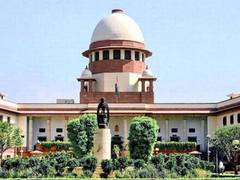
The Supreme Court recently rejected the petitions seeking review of the Constitution Bench judgment that ruled that state has power to sub-classify Scheduled Castes and Scheduled Tribes (SCs/STs).
ANI
Oct 04, 2024 18:36 IST


New Delhi [India], October 4 (ANI): The Supreme Court recently rejected the petitions seeking review of the Constitution Bench judgement that ruled that state has power to sub-classify Scheduled Castes and Scheduled Tribes (SCs/STs).
The order was delivered by the seven-judge bench led by Chief Justice of India DY Chandrachud.
"The review petitions are dismissed. Having perused the review petitions, there is no error apparent on the face of the record. No case for review under Order XLVII Rule 1 of the Supreme Court Rules 2013 has been established," the top court said.
The review petition was filed challenging the top court August 1's judgement. On August 1, the Supreme Court ruled by a majority judgement of 6:1 that sub-classification within the scheduled caste and scheduled tribes (SC/STs) reservation is permissible.
As many as six separate opinions were delivered in the case. The judgement was delivered by the seven-judge bench led by Chief Justice of India DY Chandrachud which overruled earlier judgments in EV Chinnaiah case which had held that sub-classification was not permissible because SC/STs form homogenous classes.
Besides CJI Chandrachud, other judges on the bench were Justices BR Gavai, Vikram Nath, Bela M Trivedi, Pankaj Mithal, Manoj Misra, and Satish Chandra Sharma. Justice Bela M Trivedi, in a dissenting opinion said that she disagreed with the majority judgement that sub-classification within the scheduled caste and scheduled tribes is permissible.
In a judgement written by Chief Justice of India D Y Chandrachud and Manoj Misra, they opined that Article 14 of the Constitution permits sub-classification of a class which is not similarly situated for the purpose of the law.
The Supreme Court opined the need of the identifying creamy lawyer in SC/STs as four out of seven judges of Constitution Bench suggested to exclude these people from the benefit of affirmative reservation. Justice BR Gavai had expressed his view that the state must evolve a policy for identifying the creamy layer for the Scheduled Castes and Scheduled Tribes (SC/STs).
Additionally, the top court said that for a valid exercise of power to sub-classify under Article 16(4) it is required to collect quantifiable data with respect to the inadequacy of representation of the sub-categories in the services of the state.
"The State must collect data on the inadequacy of representation in the "services of the State" because it is used as an indicator of backwardness; and Article 335 of the Constitution is not a limitation on the exercise of power under Articles 16(1) and 16(4). Rather, it is a restatement of the necessity of considering the claims of the Scheduled Castes and the Scheduled Tribes in public services. Efficiency of administration must be viewed in a manner which promotes inclusion and equality as required by Article 16(1)," CJI said.
"As held in the preceding section, the inadequacy of representation is an indicator of backwardness and thus, to use the cadre as a unit to determine representation alters the purpose of the indicator itself. The state while deciding if the class is adequately represented must calculate adequacy based on effective and not quantitative representation," CJI Chandrachud said.
The top court had said, though sub-categorization based on each caste is permissible, we are of the opinion that there can never be a situation where seats are allocated for every caste separately. Though each caste is a separate unit, the social backwardness suffered by each of them is not substantially distinguishable to warrant the State to reserve seats for each caste. If the social backwardness of two or more classes is comparable, they must be grouped together for the purposes of reservation.
"Article 14 of the Constitution permits sub-classification of a class which is not similarly situated for the purpose of the law. The court while testing the validity of sub-classification must determine if the class is a homogenous integrated class for fulfilling the objective of the sub-classification. If the class is not integrated for the purpose, the class can be further classified upon the fulfilment of the two-prong intelligible differentia standard," CJI Chandrachud said in its August 1's order.
"In Indra Sawhney (supra), this Court did not limit the application of sub-classification only to the Other Backward Class. This Court upheld the application of the principle to beneficiary classes under Articles 15(4) and 16(4)," CJI Chandrachud said.
"Article 341(1) does not create a deeming fiction. The phrase "deemed" is used in the provision to mean that the castes or groups notified by the President shall be "regarded as" the Scheduled Castes. Even if it is accepted that the deeming fiction is used for the creation of a constitutional identity, the only logical consequence that flows from it is that castes included in the list will receive the benefits that the Constitution provides to the Scheduled Castes. The operation of the provision does not create an integrated homogenous class," CJI Chandrachud said in its August 1's order.
Sub-classification within the Scheduled Castes does not violate Article 341(2) because the castes are not per se included in or excluded from the List, the top court has held.
The top court has said that sub-classification would violate the provision only when either preference or exclusive benefit is provided to certain castes or groups of the Scheduled Castes over all the seats reserved for the class.
The Seven Judge Constitution Bench was dealing with issues relating to the sub-classification of reserved communities like SCs and STs.
The Supreme Court was dealing with the constitutional validity of Section 4(5) of the Punjab Act, which depends upon whether any such classification can be made within the class of Scheduled Castes or Scheduled Tribes or whether they are to be treated as a homogenous class. (ANI)
Get the App