Separation of powers is key but courts can't stay silent in matters involving fundamental rights: former CJI Chandrachud
The underlying idea of the doctrine of separation of power is that the organs of the government do not overlap or interchange the functions that are exercised by them individually.
ANI
Nov 24, 2024 15:59 IST

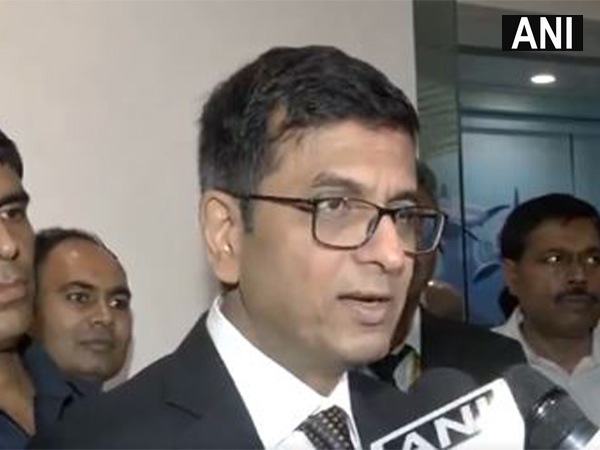
New Delhi [India], November 24 (ANI): Former Chief Justice of India DY Chandrachud, speaking about the doctrine of separation of powers, opined that the courts can't stay silent in matters where there are no firm policies in place involving people's fundamental rights.
The doctrine of separation of powers is a very important convention which India has adopted. According to which the state power is divided into three different branches- legislative, executive, and judiciary, and the idea behind this doctrine is that no one entity should be empowered with all these three powers. The underlying idea of the doctrine of separation of power is that the organs of the government do not overlap or interchange the functions that are exercised by them individually.
"There are times when the doctrine of separation of powers come under strain, there can be no denying that," Chandrachud said on Sunday, in an interaction with NDTV.
Separation of powers postulate that lawmaking will be carried out by legislator, execution by executives, and the judiciary will interpret the law and decide disputes, former CJI said.
Policymaking is the domain of the legislators and the government.
"There are spaces where there is no policy. Will courts stay silent?," Chandrachud asked, referring to the matter of pollution in Delhi.
"Sometimes, there is a problem about inadequate enforcement of law in which courts have to step in. Let's take the case of pollution. At a certain level you can say it is in the domain of the government or it is a policy issue... If you look at it very carefully, you will find that apart from just being a pure policy issue, they raise questions about fundamental rights," he said.
"Its important that we understand that these cases depend upon our assessment of the fundamental rights of our citizens. So courts cannot step aside and say that this is an issue of policy matter which we cannot decide," he said.
He also gave an example when the Supreme Court had put out guidelines to deal with sexual harassment at workplaces, until the parliament enacted a law. When fundamental rights are involved, the courts are duty bound under the Constitution to step in.
Further, talking about separation of powers, Chandrachud noted that with the formation of various regulatory agencies - SEBI, CCI, among others - the powers that were earlier exclusively entrusted with the courts to interpret the law are now taking over by those regulators.
"These expert regulatory agencies - SEBI, CCI, and others - are doing the functions that were earlier the core functions of courts. That again is a change from the traditional idea of separation of powers. Separation of powers as a basic concept of democracy is alive and well in our society, but there has some change because of the complexity of the modern day and age that we live in."
In his interview with NDTV, he also spoke about his post-retirement days. Chandrachud confessed that it was not easy for him to shift to a new lifestyle after having spent decades in courts studying, dictating, and scripting orders.
"In my life, I have got many things but at the same time I sacrificed many things. I missed lunch with my family, I missed dinners because I had to stay late in office. But, its beautiful to be a private citizen now, not bound by the restraints and responsibilities of judicial office," he said.
He said it is the Constitution of India that has pushed him every day to the corridors of the courts and uphold the values of the constitution.
Dhananjay Yashwant Chandrachud retired on November 10, making way for Justice Khanna, who will serve a six-month tenure as the Chief Justice.
Born on May 14, 1960, Justice Khanna began his legal career in 1983 by joining as an advocate with the Delhi Bar Council. He has experience in a wide range of legal fields, including constitutional law, taxation, arbitration, commercial law, and environmental law. Justice Khanna also worked as senior standing counsel for the Income Tax Department, representing the National Capital Territory of Delhi.
He was elevated as an additional Judge of the Delhi High Court in 2005 and was made a permanent judge in 2006. Justice Khanna was elevated as a Judge of the Supreme Court on January 18, 2019. (ANI)
Get the App