Reviving a 600-year-old legacy: Mridul Barua keeps manuscript painting alive in Assam's Majuli
In the heart of Majuli, the world's largest inhabited river island, Mridul Barua is leading a quiet yet powerful cultural revolution--by keeping alive the ancient art of manuscript painting, a 600-year-old tradition that traces its roots to the great saint and reformer, Srimanta Sankardeva.
ANI
Jul 19, 2025 09:03 IST

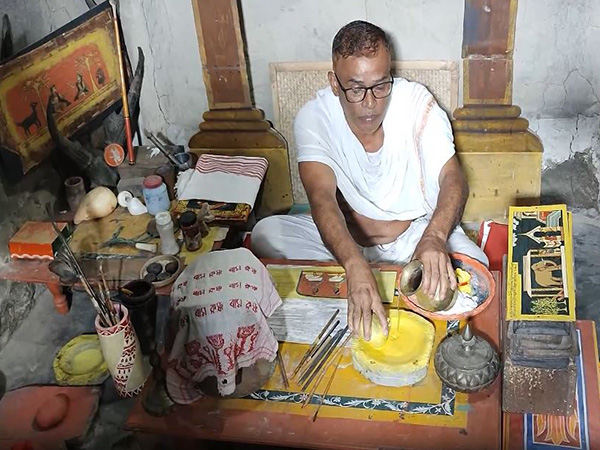
Majuli (Assam) [India], July 19 (ANI): In the heart of Majuli, the world's largest inhabited river island, Mridul Barua is leading a quiet yet powerful cultural revolution--by keeping alive the ancient art of manuscript painting, a 600-year-old tradition that traces its roots to the great saint and reformer, Srimanta Sankardeva.
Sankardeva introduced manuscript writing as a means to spread the Neo-Vaishnavite movement, using vivid illustrations and script to convey religious teachings. Around the same time, the Ahom kings also adopted this technique to document royal chronicles.
These manuscripts, painted on the bark of the Agarwood tree (locally known as Sanshi), used natural colors like hengul (vermillion) and haital (yellow arsenic), avoiding any synthetic or chemical substances--a tradition that Mridul Barua continues to this day.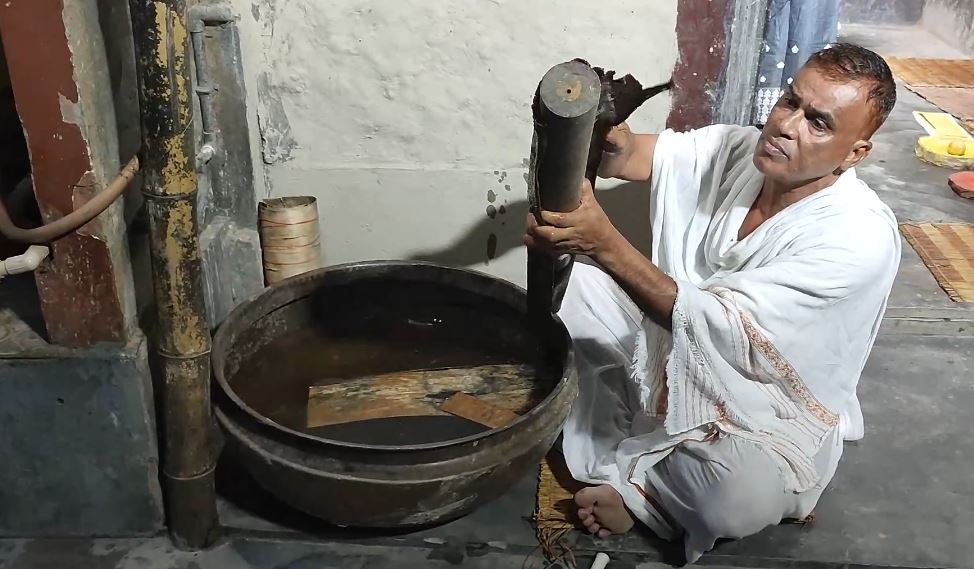
Speaking to ANI, Barua said, "This is a very old art form of Assam, which first began in 1467 during the time of the Ahom reign. Srimanta Shankar Deva, the great saint of Assam, transformed this art into a religious medium. He used this art form to depict holy texts such as the Ramayana, Mahabharata, and various Shastras."
"When Shankar Deva was 19 years old, he travelled across many parts of India and learned about the Vaishnavite religion. Upon returning to Assam, people often asked him what deities looked like. To explain, he created a dramatic performance called Sihna Yatra, where he used scroll paintings to visually represent the divine figures," he said.
"In these paintings, he used natural colors like Hengul and Haital, whose scientific names are Mercury Oxide and Arsenic Sulfide, respectively. Before this, there were paintings in Assam, but they were not permanent. It was Srimanta Shankar Deva who introduced the concept of permanent painting, even creating long-lasting ink for text," he added.
"I am a palaeographer, and through studying ancient scripts, I have discovered that these old manuscript paintings also contain knowledge of medical science, astrology, and more. I am the third generation in my family to carry forward this legacy. My father passed away when I was just five years old, and since then, I have continued practising this traditional art form," he explained.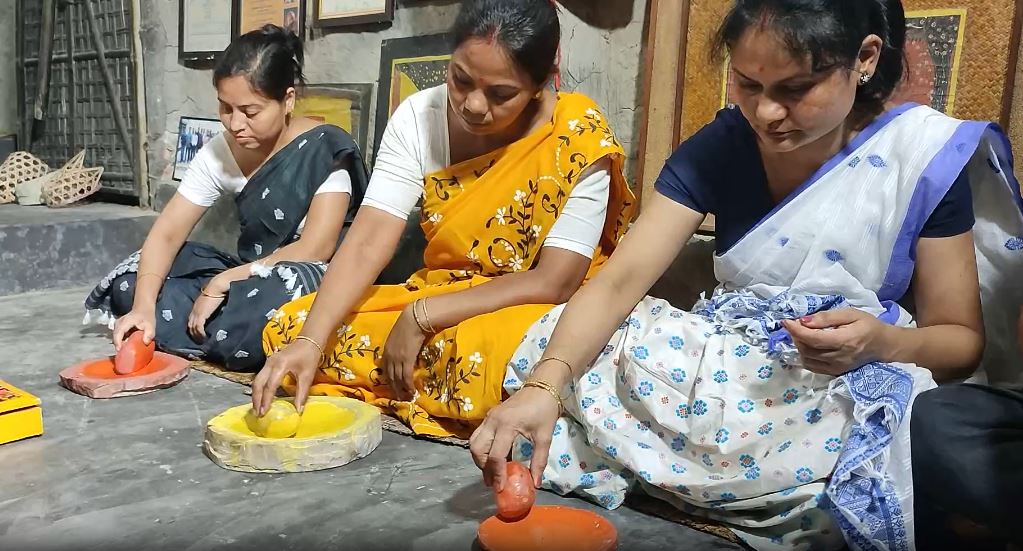
Barua, a cultural torchbearer of this dying art form, has stayed true to the traditional process. The bark is dried naturally, treated carefully, and then painted with organic pigments.
"First, we peel the bark of the Agaroo tree. Then we dry it in the sun. After that, we soak the bark in water for one day. Once soaked, we smooth the rough side using a cutter. Next, we paint it and let it dry for two days. After drying, we further smooth the surface using a stone and a shankh (conch shell). Then, we prepare a paste made from sticky rice and rohar dal, and apply a thin layer of it on the bark."
"After applying the paste, we let it dry completely. Finally, we paint on it using Hengul and Haital--traditional natural pigments. No chemical colours are used in the process."
Mridul's dedication to authenticity has earned manuscript painting a Geographical Indication (GI) tag and brought him numerous awards and recognitions, both at home and abroad.
"We exhibit this traditional form of painting all over India. We also teach many people, including students from various institutions, as well as both domestic and foreign tourists. Through NABARD, we applied for a GI Tag, and we were successful in obtaining it. After receiving the GI Tag, more visitors started coming here. Yes, we have received several awards from the state government and have also been felicitated by many institutions," said Mridul.
"This art form is our livelihood. Though it does not provide much income, my family is managing well. The most important thing is that this 600-year-old art form must survive. My forefathers never practised this craft for recognition. But times have changed now. I continue this work and teach the younger generation so that this legendary manuscript painting tradition lives on," he added.
But Mridul's mission goes beyond personal acclaim. His work has travelled across the country, with exhibitions and sales in cities like Delhi and Mumbai. Notably, his manuscript paintings have even found a place in the newly constructed Ram Mandir in Ayodhya, a proud moment for him and the people of Majuli.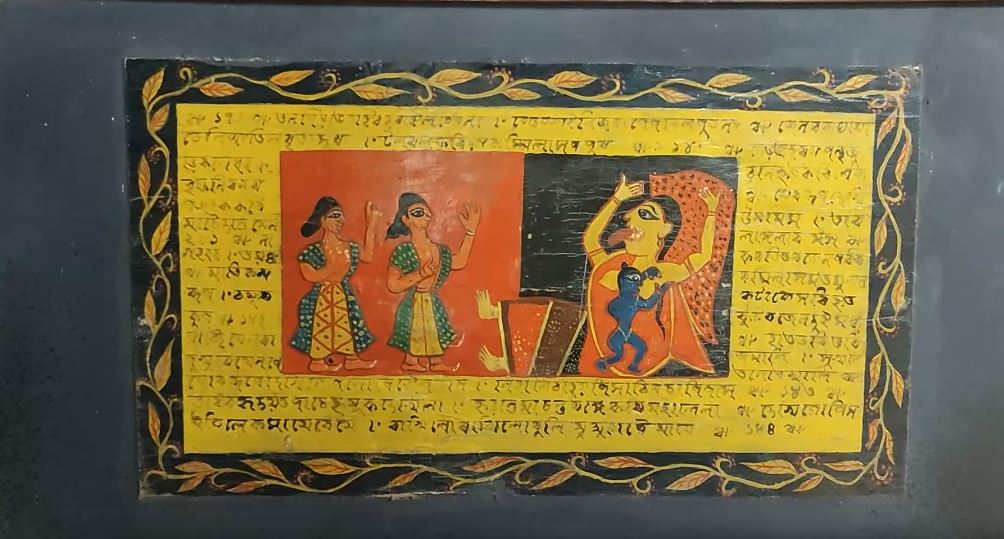
Tourists--both domestic and international--often stop by his humble workshop to learn, observe, and purchase these exquisite pieces. The revenue from these sales supports Mridul's family and the students involved, providing a rare blend of cultural preservation and economic empowerment.
"I am a recognised Guru of manuscript painting. We are continuing the traditional Guru-Shishya Parampara (teacher-disciple tradition).
"The young generation that comes here is not addicted to mobile phones or the internet. They focus on learning this art form and will carry forward the legacy of these legendary manuscript paintings. They are also gaining a source of income through this craft. Many of them create manuscript paintings, traditional dolls, and other handicrafts that are in great demand in cities like Mumbai, Delhi, and others," he said.
"We sell the products made by them, and in return, they receive financial support. The students who come here learn the art sincerely and stay away from bad influences. Currently, around 200 students are actively learning here, and over 1,000 more have registered," he added.
"Our time will end one day, but the youngsters who are learning now will carry this legacy forward. I want to appeal to the younger generation--come and learn these traditional art forms. Let us all work together to preserve our ancient culture and rich heritage," said Mridul.
Mridul passionately teaches the art form to the younger generation in Majuli, including more than 200 children. While younger kids begin their training using acrylics and paper, those who reach their fourth or fifth year of practice are gradually introduced to the authentic manuscript techniques.
Another teacher, Julee Baruah, who teaches this art form, said, "There are around 200 students here who are learning the art of manuscript painting. We truly enjoy teaching them. For the younger students, we do not use the real manuscripts, as the traditional process is long and complicated. Instead, we teach them using acrylic paints and paper. For students in their 3rd or 4th year, we begin teaching them the authentic, traditional process of manuscript painting."
"This can become a profession, and one can earn a livelihood from it. My family and I are also engaged in this work. So, I believe these children can also make it their profession in the future," she added.
More than just an artist, Mridul Barua is a mentor and a guardian of Assam's artistic heritage. He hopes that his descendants and students will carry the torch forward, ensuring that this sacred tradition not only survives but thrives in the years to come.
Apart from this, a student of manuscript painting named Alphool Saikia shared his experience, saying, "I have been doing this since I was in 2nd standard. Now, I am in class 7. I enjoy this painting very much."
"In this school, I am in the 3rd grade. Simply speaking, I like all art forms, but these manuscript paintings are the most precious to me. I believe every generation should learn and enjoy these beautiful paintings," he added. (ANI)
Get the App