Ninth Prof Sarat Mahanta Memorial Lecture on 'Bharat Varsha--The Origins Of Our Civilisational Identity' held in Guwahati
Sanyal, who has authored several books on Indian history besides six editions of the Economic Survey of India, cited a plethora of ancient texts and historical accounts to effectively demolish what he termed was the "colonial denial of Indian civilisational identity".
ANI
May 02, 2024 09:32 IST

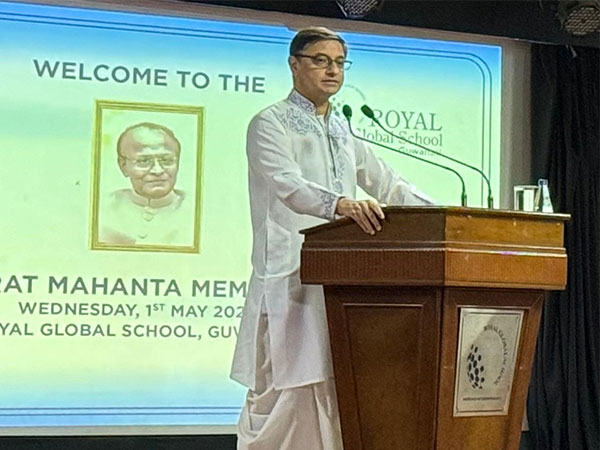
Guwahati (Assam) [India], May 2 (ANI): Bharatvarsha, which is India is an ancient civilisational nation and not, as is claimed by some, a mere union of states according to Sanjeev Sanyal, a member of Prime Minister's Economic Advisory Council.
Sanyal said this on Wednesday while delivering the 9th Professor Sarat Mahanta Memorial Lecture on 'Bharat Varsha--The Origins Of Our Civilisational Identity' held at the Royal Global University in Guwahati.
Sanyal, who has authored several books on Indian history besides six editions of the Economic Survey of India, cited a plethora of ancient texts and historical accounts to effectively demolish what he termed was the "colonial denial of Indian civilisational identity".
He quoted Sir John Strachey, the acting Viceroy of India in 1872 who said, "The first and most essential thing to learn about India is that there is not, and never was, an India". Winston Churchill has also said that "India is a geographical term, no more a united nation than the equator".
Marxist historians and a section of the west-leaning elite in India have also been propagating this falsehood for their own vested interests, said Sanyal.
The Bharatas, he contended, were people that lived and flourished in the ancient Harappan civilisation on the 'land of the seven rivers', or the 'Sapta Sindhu' in the Saraswati and Ghaggar basin. Contrary to popular belief, the original seven rivers were the Saraswati and it's tributaries and did not include the rivers of Punjab. The Saraswati river, on whose banks lived a Vedic tribe by the name of Bharata-Trutsu, is also referred to as Bharati and finds mention in the Rig Veda seventy two times. The river dried up around 200 BCE (Before Common Era).
In chapter 38 of the Mahabharat's Book IX (Shalya Parva), Balaram's 'teertha' is called 'Sapta Saraswati', he said.
Sanyal, who graduated in economics from Shri Ram College of Commerce in Delhi, before studying at St. John's College, Oxford, took a deep dive into ancient history to retrieve nuggets in support of his argument.
The first known empire in Bharatvarsha, he said, was formed by Sudasa, the chieftain of the Bharatas, who became a 'Chakravartin' after defeating a confederacy of ten tribes on the banks of Parushni (Ravi) and then Bheda on the Yamuna.
Assimilation and not imposition, contended Sanyal, was the bedrock of the Indic civilisation. This is amply demonstrated by the the Bharatas' act of compiling all the existing wisdom of the tribes they defeated into the Vedas. The Vedas are, he added, explicitly a 'samhita' or compilation and do not claim to be the origin. The Rig Veda, thus, begins with a chant paying respect to both 'ancient' and 'modern' sages.
The symbol of the Charavartin (universal monarch) was the spoked wheel, which was the same as the Mauryan 'chakra' that finds its place in India's national flag. This strongly suggests a civilisational continuum, contended Sanyal who was the managing director and global strategist at Deutsche Bank.
An interesting pivot of the Indic civilisation, pointed out Sanyal, was that it was based on a 'civilisational contract'. The last hymn of the Rig Veda explicitly lays out that all ancient God's have a place around a common sacred fire.
"By not inviting Shiva, Sati's father Daksha violated the Rig Vedic compact which led to Sati sacrificing herself to the fire and ending the yagya. The parts of Sati's body that scattered all over the Indian subcontinent, or Bharatvarsha, symbolically united the sacred landscape of India," Sanyal said.
Sanyal contended that the idea of 'Sapta Sindhu' spread in the post-Vedic texts to cover the entire subcontinent. The Puranas and the epics suggest a clear knowledge of the sub-continent's civilisational unity. He cited chapters from the Brahma Purana that mention the geographical boundaries of 'Bharata' whose people are called 'Bharatis'.
The economist and popular historian also underlined the fact that Tamil identity is clear rooted in Vedic civilization. The preface of 'Tolkapiyyam', the oldest text of Sangam (the oldest Tamil literature) dating back to the 2nd century BCE, states that the text is rooted in the "wisdom of the four Vedas".
This aspect is significant in light of the attempts made by some circles in Tamil Nadu and other southern states to create a false narrative of Dravidian civilisation being distinct and separate from Indic civilisation.
Sanyal refers to accounts of Chinese, Greek, Arab and other foreign visitors who clearly described India and a geographical and civilisational unity.
For example, the ancient Greco-Romans referred to the subcontinent as Indoi while Megasthanes wrote of it as Indika. The ancient Chinese had several variations on Sindhu: Yuandu, Tianzhu etc.
"The ancient Egyptians referred to Bharat as H-n-d-w-y (in their hieroglyphs) while medieval Arabs mentioned it as al-Hind in their accounts. Al-Beruni's book on India describes the civilisational unity of Bharat despite political divisions and provides clear estimates of distances as measured from Kannauj and a sacred tree in Prayag.Our epics also lay out the contours of Bharatvarsh," said Sanyal.
"Rishi Kashyap is said to have created Kashmir by swallowing the waters of a lake. Prahlad, the Asura prince, is associated with Multani while his grandson, Mahabali, is associated with Kerala. Mahabali was blessed by Vishnu and Onam is celebrated in his name. Mahabali's son Banaura is associated with Assam and had his capital at Sonitpur in modern-day Tezpur. His daughter Usha married Krishna's grandson Aniruddha. Notice here the four corners of the country that are laid out," Sanyal said.
Shankara, or the Adi Shankaracharya, toured the subcontinent in the 8th century CE and established 'mathas' at Puri, Sringeri, Dwarka and Badrinath which approximate the four corners of India.
In Jain, Buddhist and Puranic texts, said Sanyal, Bharat is often referred to as 'Jambudwipa'. The simplest explanation for this is that the subcontinent resembles the shape of a 'jambu' or Rose apple fruit--broad at the top (the Himalayas) and narrow towards the bottom (peninsular India).
Even in the medieval period, there are references to Jambudwipa. For instance, during the revolt of the Poligars (Palaiyakkarars of the former Tirunelveli kingdom in Tamil Nadu) against the East India Company, their chief Marudu Pandyan made a declaration of independence in 1801 that referred to "the castes and people that are in the Jambu subcontinent of Jambu Dwipa..".
"The idea of India as a civilisational nation is clearly very ancient, but it is not static, rigid or pure. It has evolved over thousands of years to include many new ideas including foreign influences that came through trade, migration, invasion and exchange of ideas," said Sanyal.
However, he added, acknowledging the importance of foreign contributions need not extend to celebrating our own subjugation. "The geographical expanse of our civilization once included other parts of Asia and this civilisational link is proudly acknowledged in countries like Indonesia," he said.
Sanyal then referred to the founders of the modern Indian republic who were conscious that it is the modern manifestation of an ancient civilisational nation. Jawaharlal Nehru, in his famous 'freedom at midnight' speech, said, "the soul of a nation, long suppressed, finds utterance".
The first line of the Constitution says, "India, that is Bharat, shall be a Union of states".
Ambedkar, in his speech to the Constituent Assembly on November 4, 1948, issues this clarification on the draft Constitution: "Though the country and the people may be divided into different states for convenience of administration, the country is one integral whole, it people a single people living under a single imperium derived from a single source. The Drafting Committee thought it was better to make it clear at the onset than to leave it to speculation or to dispute".
Sanyal's address was supplemented by another very interesting presentation by Nabaarun Barooah who is pursuing his Master's degree at Oxford University.
Barooah traced the untold history of what he termed was Assam's earliest defender--Prithu, the Rai of Kamrup. He concluded by stating that while Lachit Borphukan's heroics are being finally honoured by the nation, Prithu still awaits his due. (ANI)
Tags:
Get the App