Amit Shah expresses gratitude to PM Modi after cabinet approves Rs 20,774 crore for Ladakh-Kaithal power transmission line
After the Union Cabinet approved the project to set up a 5 gigawatts solar power transmission line from Ladakh to Kaithal in Haryana, Union Home Minister Amit Shah on Wednesday thanked the Prime Minister and said that is a giant stride towards realizing Modi Ji's vision to make India self-reliant in energy production.
ANI
Oct 18, 2023 22:11 IST

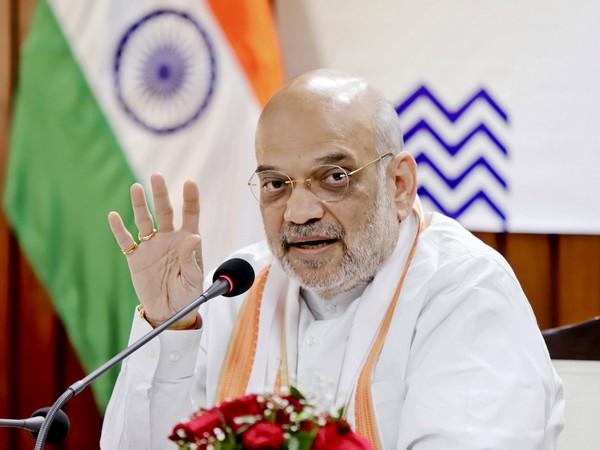
New Delhi [India], October 18 (ANI): After the Union Cabinet approved the project to set up a 5 gigawatts solar power transmission line from Ladakh to Kaithal in Haryana, Union Home Minister Amit Shah on Wednesday thanked the Prime Minister and said that is a giant stride towards realizing PM Modi's vision to make India self-reliant in energy production.
Taking to the social media platform, X, the Union Home Minister said, "Gratitude to PM @narendramodi Ji for approving Rs20,773.70 crore to set up a 5 gigawatts solar power transmission line from Ladakh to Kaithal in Haryana. The project under the Green Energy Corridor Phase-II - Inter-State Transmission System is a giant stride towards realizing Modi Ji's vision to make India self-reliant in energy production."
The Union Cabinet, chaired by Prime Minister Narendra Modi, today approved the project on Green Energy Corridor (GEC) Phase-II - Inter-State Transmission System (ISTS) for 13 gigawatt renewable energy project in Ladakh.
The project is targeted to be set up by financial 2029-30 with a total estimated cost of Rs 20,773.70 crore and central financial assistance at 40 per cent of the project cost - Rs 8,309.48 crore.
Keeping in view the complex terrain, adverse climatic conditions and defence sensitivities of the Ladakh region, Power Grid Corporation of India Limited (POWERGRID) will be the implementing agency for this project.
The transmission line for evacuating this to-be-produced power will pass through Himachal Pradesh and Punjab up to Kaithal in Haryana, where it will be integrated with the national grid.
An interconnection is also planned from this project in Leh to the existing Ladakh grid so as to ensure a reliable power supply to Ladakh."It will also be connected to the Leh-Alusteng-Srinagar line to provide power to Jammu and Kashmir. The project will entail setting up of 713 km transmission lines (including 480 km HVDC line) and 5 GW capacity of HVDC terminal each at Pang (Ladakh) and Kaithal (Haryana)," the government said in a release.
The project will contribute to achieving the target of 500 GW of installed electricity capacity target from non-fossil fuels by the year 2030.
Prime Minister Modi, during his Independence Day Speech in 2020, announced the setting up of a 7.5 GW solar Park in Ladakh.
After an extensive field survey, the Ministry of New and Renewable Energy (MNRE) prepared a plan to set up a 13 GW renewable energy generation capacity along with a 12 GWh battery energy storage system in Pang, Ladakh.
Keeping in mind the rising demands for energy and to meet its target of achieving 50 per cent of the needs through renewable energy, the central government in early September decided to provide viability gap funding to companies for setting up battery energy storage systems.
India aims to meet its 50 per cent energy needs through renewable sources by 2030.
The government will spend Rs 3,760 crore as viability gap funding and it will be a 100 per cent central grant. The viability gap funding is capped at 40 per cent of the total capital cost of the project.
Viability gap funding is given to support infrastructure projects that are economically justified but fall marginally short of finances.
At the COP26 summit in Glasgow in 2021, Prime Minister Narendra Modi had committed to an ambitious five-part "Panchamrit" pledge, including reaching 500 GW of non-fossil electricity capacity, to generate half of all energy requirements from renewables, to reduce emissions by 1 billion tons by 2030.
India also aims to reduce the emissions intensity of GDP by 45 per cent. Finally, India commits to net-zero emissions by 2070.
India meets a sizable portion of its energy needs through imports, and new energy sources are seen as an avenue to reduce the dependence on imported fuel. (ANI)
Get the App