79th Independence Day: Let's know history and significance of Tricolour
The Indian national flag, also known as the Tiranga, was officially adopted on July 22, 1947. Its design features three equal horizontal stripes - deep saffron at the top, white in the middle, and dark green at the bottom. The white band has a navy blue wheel, known as the Ashoka Chakra, with 24 spokes.
ANI
Aug 14, 2025 16:29 IST

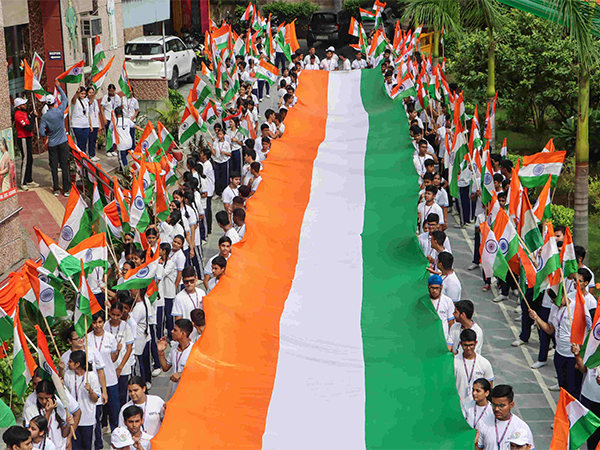
New Delhi [India], August 14 (ANI): India's 79th Independence Day celebrations are around the corner, and the tricolour is fluttering high across the nation. Let's dive into the history and significance of our beloved national flag.
The Indian national flag, also known as the Tiranga, was officially adopted on July 22, 1947. Its design features three equal horizontal stripes - deep saffron at the top, white in the middle, and dark green at the bottom. The white band has a navy blue wheel, known as the Ashoka Chakra, with 24 spokes.
The Dharma Chakra, featured in the Sarnath Lion Capital created by Mauryan Emperor Ashoka in the 3rd century BC, symbolises the "wheel of the law."
The tricolour embodies the struggles, sacrifices, and aspirations of a nation that fought tirelessly for its freedom. It represents unity, diversity, and the country's rich cultural heritage. The Flag Code of India, 2002, governs the display of the flag, ensuring it's treated with respect and dignity.
While the Flag Code of India, 2002, encapsulates the respect and dignity that Tiranga deserves. It governs the display of the flag by private, public, and government institutions, ensuring that it is treated with the reverence it commands. Whether hand-spun in Khadi or machine-made in polyester, the flag is to be treated as the nation's pride.
The code emphasises the correct way to display the flag, ensuring it is always accorded the highest honour, never allowed to touch the ground or trail in the water, and disposed of respectfully when damaged.
On Independence Day, the national flag is placed at the bottom of the pole and raised (hoisted) to the top by the Prime Minister. In contrast, on Republic Day (January 26), the flag is folded or rolled and attached at the top of the pole, from where the President unfurls it without being pulled up.
The first unofficial national flag was hoisted on August 7, 1906, in Parsee Bagan Square, Calcutta (now Kolkata). Designed by Sachindra Prasad Bose and Hemchandra Kanungo, it featured three horizontal stripes - green, yellow, and red - with eight white lotuses, a sun, and a crescent moon.
In 1907, Madam Bhikaiji Cama designed a flag that was similar to the Berlin Committee Flag, featuring three horizontal stripes - saffron, green, and red - representing courage, faith, and sacrifice.
In 1917, a flag was hoisted during the Home Rule Movement, signalling the demand for self-governance.
In 1921, Pingali Venkayya designed the Swaraj Flag, which was later modified to include a spinning wheel and three colours - red, green, and white - representing the major communities in India. Mahatma Gandhi suggested adding a white stripe to symbolise peace and other communities.
The flag underwent significant changes, and by 1931, it featured saffron, white, and green stripes with the spinning wheel, symbolising bravery, peace, and prosperity.
Jawaharlal Nehru played a crucial role in modifying the flag by replacing the spinning wheel with the Ashoka Chakra.
The final transformation came in 1931, the flag's colours were finalised - saffron for courage, white for peace, and green for fertility and growth. The Dharma Chakra replaced the spinning wheel, symbolising the eternal wheel of law and progress.
On July 22, 1947, the Constituent Assembly adopted the tricolour flag with the Ashoka Chakra, designed by Surayya Tyabji, replacing the spinning wheel. The flag's colours - saffron, white, and green - represent courage, peace, and fertility, while the Ashoka Chakra symbolises law, justice, and righteousness.
The Indian National Flag was officially adopted on August 15, 1947, and has since been a symbol of national pride and unity.
On August 15, 2025, India will celebrate its 79th Independence Day with grand ceremonies at the Red Fort in New Delhi. The theme for this year's celebration is "Naya Bharat," reflecting India's vision of becoming a developed nation by 2047. The event will feature a 21-Gun Salute, cultural displays, and tributes to India's journey towards progress and prosperity. (ANI)
Get the App