Researchers figure out formula for perfect shot of espresso
Washington D.C. [USA], Jan 25 (ANI): While coffee is the perfect stress buster for most of the people, brewing a perfect cup of Cappuccino, Latte or Mocha may not be an easy task. The formula to make a perfect shot of espresso has been decoded by a group of experts from different scientific fields, such as maths, physics, and material science. In the study, experts from different fields joined hands to figure out the formula for a perfect shot of espresso.
ANI
Jan 25, 2020 18:02 IST

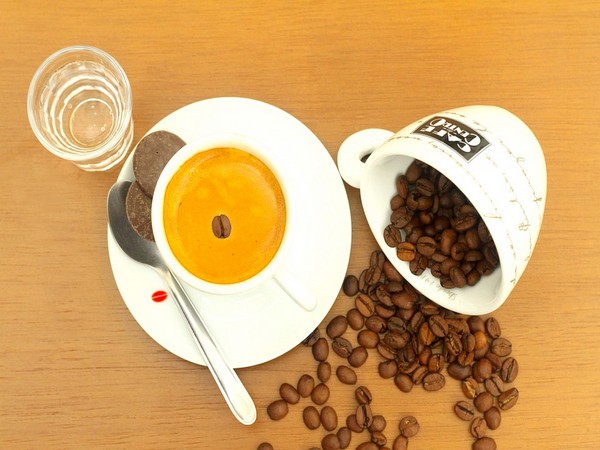
Washington D.C. [USA], Jan 25 (ANI): While coffee is the perfect stress buster for most of the people, brewing a perfect cup of Cappuccino, Latte or Mocha may not be an easy task. The formula to make a perfect shot of espresso has been decoded by a group of experts from different scientific fields, such as maths, physics, and material science. In the study, experts from different fields joined hands to figure out the formula for a perfect shot of espresso.
The scientists from the United States, the United Kingdom, Ireland, Australia, and Switzerland reached the conclusion that contrary to the common practice, fewer coffee beans which are ground more coarsely are the key to a drink that is cheaper to make, more consistent from shot to shot, and just as strong. The study was published in the journal Matter.
"Most people in the coffee industry are using fine-grind settings and lots of coffee beans to get a mix of bitterness and sour acidity that is unpredictable and irreproducible," says co-senior author Christopher Hendon a computational chemist at the University of Oregon.
"It sounds counterintuitive, but experiments and modelling suggest that efficient, reproducible shots can be accessed by simply using less coffee and grinding it more coarsely."
Though lots of factors are involved, the norm for brewing an espresso shot is to grind a relatively large amount of coffee beans (~20 grams) almost as finely as possible. The fine grind, common sense goes, means more surface area exposed to the brewing liquid, which ought to boost extraction yield.
But when the researchers put together a mathematical model to explain the extraction yield based on the factors under a barista's control--options such as the masses of water and dry coffee, the fineness or coarseness of the grounds, and the water pressure--and compared its predictions to brewing experiments, it became clear that the real relationship was more complicated.
Grinding the beans finely--as according to the industry standards--clogged the coffee bed, reduced extraction yield, led to wastage of raw material and introduced variation in taste.
Much number crunching and thousands of shots later, the team reached a recipe to simultaneously maximise extraction and produce espresso that would taste similar from one cup to the next. "One way to optimise extraction and achieve reproducibility is to grind coarser and use a little less water, while another is to simply reduce the mass of coffee," Hendon says.
Developing a model representative of espresso brewing was not a straightforward task. At a basic level, extraction yield depends on how water flows under pressure through a mass of coffee grounds. But that mass is made up of millions of individual grains of different shapes and sizes, jammed irregularly into a single filter bed.
"You would need more computing power than Google has to accurately solve the physics and transport equations of brewing on geometry as intricate as a coffee bed," says co-senior author Jamie M. Foster, a mathematician at the University of Portsmouth (UK).
To get past this hurdle, the researchers drew on an unlikely source--electrochemistry--likening how caffeine and other molecules dissolve out of coffee grounds to how lithium ions move through the electrodes of a battery.
Borrowing modeling methodologies from battery work led to a rigorous coffee extraction model capable of making powerful and testable predictions.
Boosting the extraction yield through one or more of the routes illustrated by the model could also lead to economic gains for cafes and to sustainability benefits for the coffee industry as a whole.
The researchers stress, however, that their results do not purport to reduce all of espresso-making down to a single set of brewing conditions or to a lone flavour profile. (ANI)
Tags:
Get the App