

ADD ANI AS A TRUSTED SOURCE
googleads
ANI Logo
Menu
Quirky

Research says, Kangaroos can communicate with humans

Kowloon [Hong Kong], December 18 (ANI): A recent study by the City University of Hong Kong in collaboration with the University of Sydney has found that unlike other domesticated animals like dogs, horses, or goats; Kangaroos, which have never been domesticated can intentionally, communicate with humans.

ANI Dec 18, 2020 09:13 IST googleads

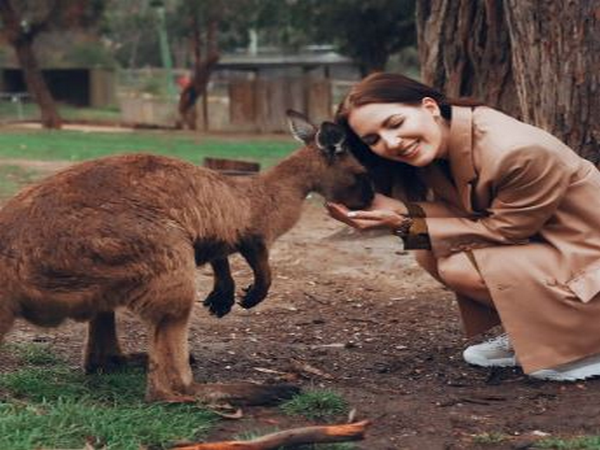
Representative Image

Kowloon [Hong Kong], December 18 (ANI): A recent study by the City University of Hong Kong in collaboration with the University of Sydney has found that unlike other domesticated animals like dogs, horses, or goats; Kangaroos, which have never been domesticated can intentionally, communicate with humans.
The research involved kangaroos, marsupials that were never domesticated, at three locations across Australia and revealed that kangaroos gazed at a human when trying to access food which had been put in a closed box. The kangaroos used gazes to communicate with the human instead of attempting to open the box themselves, a behaviour that is usually expected for domesticated animals.
Ten out of 11 kangaroos tested actively looked at the person who had put the food in a box to get it (this type of experiment is known as 'the unsolvable problem task'). Nine of the 11 kangaroos additionally showed gaze alternations between the box and the person present, a heightened form of communication where they look between the box and human.
The research builds on previous work in the field which has looked at the communication of domesticated animals, such as dogs and goats, and whether intentional communication in animals is a result of domestication.
Lead author Dr Alan McElligott, the University of Roehampton (now based at the City University of Hong Kong), previously led a study which found goats can understand human cues, including pointing, to gather information about their environment.
Dr Alan McElligott said: "Through the new study, we were able to see that communication between animals can be learnt and that the behaviour of gazing at humans to access food is not related to domestication. Indeed, kangaroos - showed a very similar pattern of behaviour we have seen in dogs, horses and even goats when put to the same test.
"Our research shows that the potential for referential intentional communication towards humans by animals has been underestimated, which signals an exciting development in this area. Kangaroos are the first marsupials to be studied in this manner and the positive results should lead to more cognitive research beyond the usual domestic species," he said.
According to Dr Alexandra Green, School of Life and Environmental Sciences at the University of Sydney, Kangaroos are iconic Australian endemic fauna which is adored by many worldwide but also considered as a pest. This research draws attention to the cognitive abilities of kangaroos and helps foster more positive attitudes towards them. (ANI)


Get the App

What to Read Next

Food

Study finds how diet has major impact on risk of Alzheimer's

Study finds how diet has major impact on risk of Alzheimer's

In a detailed study, researchers identify which diets are effective in lowering the risk of developing Alzheimer's disease.

Read More
Relationships

Moral reasoning displays characteristic patterns in brain: Study

Moral reasoning displays characteristic patterns in brain: Study

Philosophers, psychologists and neuroscientists have passionately argued whether moral judgments share something distinctive that separates them from non-moral matters. Moral monists claim that morality is unified by a common characteristic and that all moral issues involve concerns about harm.

Read More
Parenting

Kindergarten misbehaviour may cost society in the long run: Study

Kindergarten misbehaviour may cost society in the long run: Study

For the first time, a new economic analysis has linked kindergarten pupils' misbehaviour to significant societal costs in terms of criminality, associated medical expenses, and lost productivity as they grow up.

Read More
Quirky

Air pollution makes it difficult for bees to find flowers: Study

Air pollution makes it difficult for bees to find flowers: Study

According to a new study, air pollution prevents bees from finding flowers because it degrades the scent.

Read More
Quirky

Sense of order distinguishes humans from other animals: Study

Sense of order distinguishes humans from other animals: Study

Already earlier research at Stockholm University has suggested that only humans have the ability to recognize and remember so-called sequential information and that this ability is a fundamental building block underlying unique human cultural abilities.

Read More
Travel

Synchronizing with internal clocks help mitigate jet lag: Study

Synchronizing with internal clocks help mitigate jet lag: Study

Travelling to exotic locations is an excellent way to broaden one's horizons, but jet lag may be an unpleasant side effect. Adjusting to a new time zone is frequently accompanied by weariness, difficulties sleeping, and a slew of other issues that may turn an otherwise great vacation into an unpleasant one.

Read More
Quirky

Exciting the brain might be key to boosting maths learning: Study

Exciting the brain might be key to boosting maths learning: Study

According to a new study from the Universities of Surrey and Oxford, Loughborough University, and Radboud University in the Netherlands, activating a brain region with electrical noise stimulation may improve mathematical learning in those who struggle with the subject.

Read More
Quirky

Youth with poor learning skills most vulnerable to email scams

Youth with poor learning skills most vulnerable to email scams

According to an international study published in the peer-reviewed British Journal of Educational Studies, disadvantaged youth are more vulnerable to email scams and require more protection.

Read More
Food

Replacing saturated fat, salt...is tasty, healthy: Study

Replacing saturated fat, salt...is tasty, healthy: Study

A team of Penn State researchers has figured the how to reduce some saturated fat, sugar, and salt from popular American dishes while keeping them tasty.

Read More
Food

Sanitized ready-to-eat salad may contain disease-causing bacteria

Sanitized ready-to-eat salad may contain disease-causing bacteria

A review paper published in the journal Foods describes a study that provides an overview of studies on minimally processed vegetables (MPVs), with a particular focus on the Brazilian market.

Read More
Home About Us Our Products Advertise Contact Us Terms & Condition Privacy Policy

Copyright © aninews.in | All Rights Reserved.
