

ADD ANI AS A TRUSTED SOURCE
googleads
ANI Logo
Menu
Quirky

Chimpanzees help trace evolution of human speech back to ancient ancestors

London [UK], May 27 (ANI): In a study conducted by a group of researchers, one of the most promising theories for the evolution of human speech has finally received support from chimpanzee communication.

ANI May 27, 2020 10:02 IST googleads

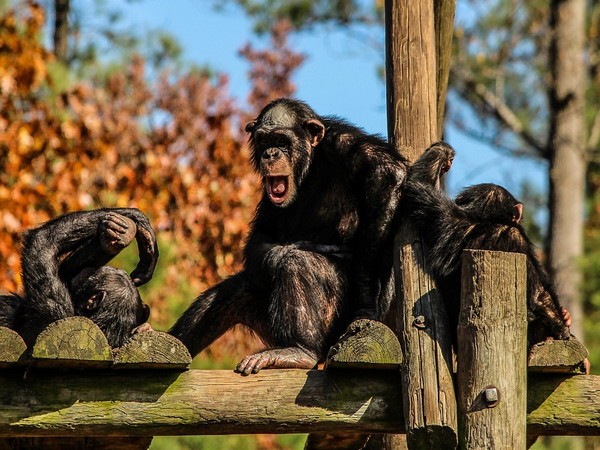
Representative image

London [UK], May 27 (ANI): In a study conducted by a group of researchers, one of the most promising theories for the evolution of human speech has finally received support from chimpanzee communication.
The evolution of speech is one of the longest-standing puzzles of evolution. However, inklings of a possible solution started emerging some years ago when monkey signals involving a quick succession of mouth open-close cycles were shown to exhibit the same pace of human spoken language.
In the paper 'Chimpanzee lip-smacks confirm primate continuity for speech-rhythm evolution', published today in the journal Biology Letters, a consortium of researchers, including St Andrews University and the University of York, led by the University of Warwick, have found that the rhythm of chimpanzee lip-smacks also exhibit a speech-like signature - a critical step towards a possible solution to the puzzle of speech evolution.
Just like each and every language in the world, monkey lip-smacks have previously shown a rhythm of about 5 cycles/second (i.e. 5Hz). This exact rhythm had been identified in other primate species, including gibbon song and orangutan consonant-like and vowel-like calls.
However, there was no evidence from African apes, such as gorillas, bonobos and chimpanzees - who are closely related to humans, meaning the plausibility of this theory remained on hold.
Now, the team of researchers using data from 4 chimpanzee populations have confirmed that they too produce mouth signals at a speech-like rhythm. The findings show there has been most likely a continuous path in the evolution of primate mouth signals with a 5Hz rhythm. Proving that evolution recycled primate mouth signals into the vocal system that one day was to become speech.
African great apes, the closest species to humans, had never been studied for the rhythm of their communication signals. Researchers investigated the rhythm of chimpanzee lip-smacks, produce by individuals while they groom another and found that chimpanzees produce lip-smacks at an average speech-like rhythm of 4.15 Hz.
Researchers used data across two captives and two wild populations, using video recordings collected at Edinburgh Zoo and Leipzig Zoo, and recordings of wild communities including the Kanyawara and the Waibira community, both in Uganda.
Dr Adriano Lameira, from the Department of Psychology at the University of Warwick comments: "Our results prove that spoken language was pulled together within our ancestral lineage using "ingredients" that were already available and in use by other primates and hominids. This dispels much of the scientific enigma that language evolution has represented so far. We can also be reassured that our ignorance has been partly a consequence of our huge underestimation of the vocal and cognitive capacities of our great ape cousins.
"We found pronounced differences in rhythm between chimpanzee populations, suggesting that these are not the automatic and stereotypical signals so often attributed to our ape cousins. Instead, just like in humans, we should start seriously considering that individual differences, social conventions and environmental factors may play a role in how chimpanzees engage "in conversation" with one another.
"If we continue searching, new clues will certainly unveil themselves. Now it's a matter of mastering the political and societal power to preserve these precious populations in the wild and continue enabling scientists to look further." (ANI)


Get the App

What to Read Next

Food

Study finds how diet has major impact on risk of Alzheimer's

Study finds how diet has major impact on risk of Alzheimer's

In a detailed study, researchers identify which diets are effective in lowering the risk of developing Alzheimer's disease.

Read More
Parenting

Kindergarten misbehaviour may cost society in the long run: Study

Kindergarten misbehaviour may cost society in the long run: Study

For the first time, a new economic analysis has linked kindergarten pupils' misbehaviour to significant societal costs in terms of criminality, associated medical expenses, and lost productivity as they grow up.

Read More
Quirky

Air pollution makes it difficult for bees to find flowers: Study

Air pollution makes it difficult for bees to find flowers: Study

According to a new study, air pollution prevents bees from finding flowers because it degrades the scent.

Read More
Quirky

Sense of order distinguishes humans from other animals: Study

Sense of order distinguishes humans from other animals: Study

Already earlier research at Stockholm University has suggested that only humans have the ability to recognize and remember so-called sequential information and that this ability is a fundamental building block underlying unique human cultural abilities.

Read More
Quirky

Exciting the brain might be key to boosting maths learning: Study

Exciting the brain might be key to boosting maths learning: Study

According to a new study from the Universities of Surrey and Oxford, Loughborough University, and Radboud University in the Netherlands, activating a brain region with electrical noise stimulation may improve mathematical learning in those who struggle with the subject.

Read More
Quirky

Youth with poor learning skills most vulnerable to email scams

Youth with poor learning skills most vulnerable to email scams

According to an international study published in the peer-reviewed British Journal of Educational Studies, disadvantaged youth are more vulnerable to email scams and require more protection.

Read More
Food

Replacing saturated fat, salt...is tasty, healthy: Study

Replacing saturated fat, salt...is tasty, healthy: Study

A team of Penn State researchers has figured the how to reduce some saturated fat, sugar, and salt from popular American dishes while keeping them tasty.

Read More
Food

Sanitized ready-to-eat salad may contain disease-causing bacteria

Sanitized ready-to-eat salad may contain disease-causing bacteria

A review paper published in the journal Foods describes a study that provides an overview of studies on minimally processed vegetables (MPVs), with a particular focus on the Brazilian market.

Read More
Quirky

Extreme weather events linked to higher child marriage: Study

Extreme weather events linked to higher child marriage: Study

One of the negative consequences of catastrophic weather incidents around the world that most people might overlook is an increase in underage marriages.

Read More
Parenting

Study reveals more sleep reduce impulsive behavior in children

Study reveals more sleep reduce impulsive behavior in children

Sleep is a vital aspect of a child's general health, but it can also influence their behaviour.

Read More
Home About Us Our Products Advertise Contact Us Terms & Condition Privacy Policy

Copyright © aninews.in | All Rights Reserved.
