

ADD ANI AS A TRUSTED SOURCE
googleads
ANI Logo
Menu
Parenting

Study suggests children can intuitively do division even before formal education

[Switzerland], February 25 (ANI): We frequently consider multiplication and division as calculations that should be taught in school. However, a research team has found that, even before children begin formal education, they possess intuitive arithmetic abilities.

ANI Feb 25, 2022 13:44 IST googleads

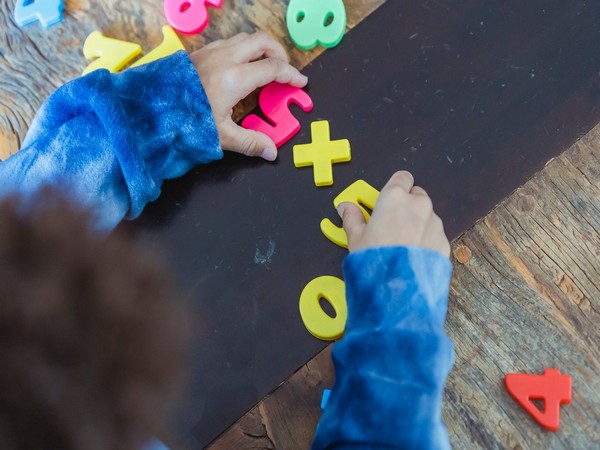
Representative image

[Switzerland], February 25 (ANI): We frequently consider multiplication and division as calculations that should be taught in school. However, a research team has found that, even before children begin formal education, they possess intuitive arithmetic abilities.
A new study which was published in the journal 'Human Neuroscience' argued that this means to do approximate calculations even extends to do that almost all dreaded fundamental math drawback-true division-with implications for a way school students are taught mathematical ideas sooner or later.
The foundation for the study is the approximate number system (ANS), a well-established theory that said people (and even nohuman primates) from an early age have an intuitive ability to compare and estimate large sets of objects without relying upon language or symbols.
For instance, under this non-symbolic system, a child can recognise that a group of 20 dots is bigger than a group of four dots, even when the four dots take up more space on a page. The ability to make finer approximations-say, 20 dots versus 17 dots-improves his adulthood.
Researchers studied ANS were interested in not just how we think about numbers before formal education, but also how to apply those findings to the classroom.
A positive result would be especially significant for low-income children - who accounted for a majority of the school-age study participants - because they are more at risk for lower math scores as they progress through school.
"The ANS is universal, and finding ways to harness the ANS might be one of many important avenues to closing the achievement gap," said Dr Elizabeth M Brannon, who leaded the Developing Minds Lab at the University of Pennsylvania in Philadelphia and co-author on the study.
Brannon and the rest of the US-based research team performed several experiments to assess the ability of six- to nine-year-old children and college students to perform symbolic and non-symbolic approximate division. The experiments were designed not only to test their hypotheses that children indeed possess the ability to perform these sorts of calculations in early childhood, but whether that number sense can be harnessed to improve mathematical learning later in life, according to Brannon.
"This question is controversial because the existing data are mixed," she explained. "However, our study gives some hope for that enterprise by showing that children can flexibly divide quantities and even symbols before they learn about formal division," she added.
In one experiment, for example, both children and adults performed non-symbolic and symbolic math problems by watching dots or numerals (the dividend) on the top of a computer screen fall onto a flower with varying numbers of petals (the divisor). Their task was to decide which quantity was greater - the dots or numbers divided among the flower's petals on the left side of the screen versus a single petal with a new quantity of dots/number on the right side of the screen.
Participants performed well above chance, with children choosing the right answer between 73% and 77% of the time, depending on whether or not they received feedback during different phases of the experiment. The adults got the right answers nearly 90% of the time.
Even children who could not answer verbal symbolic division problems did well in their experiment - a result that confirms brain imaging studies that show heightened activity in a crucial region associated with number sense.
"We were most surprised that children who could not solve any formal verbal or written division problems - for example, what is four divided by two? - were still pretty successful at the symbolic version of our flower approximate division task," Brannon noted. "So, even before formal math education, we have an approximate number sense that relies on brain regions that continue to play a role in formal mathematics." (ANI)


Get the App

What to Read Next

Quirky

Youth with poor learning skills most vulnerable to email scams

Youth with poor learning skills most vulnerable to email scams

According to an international study published in the peer-reviewed British Journal of Educational Studies, disadvantaged youth are more vulnerable to email scams and require more protection.

Read More
Parenting

Study reveals more sleep reduce impulsive behavior in children

Study reveals more sleep reduce impulsive behavior in children

Sleep is a vital aspect of a child's general health, but it can also influence their behaviour.

Read More
Parenting

Overuse of social media, gadgets becomes top parents concern

Overuse of social media, gadgets becomes top parents concern

As children return to school, two issues are rising to the top of their parents' concerns: the impact of social media and the internet on children's lives.

Read More
Education

Study reveals teens need consistent positive messaging

Study reveals teens need consistent positive messaging

Teenagers suffer academically in multicultural environments if they do not get consistent and positive signals about cultures other than their own at school, home, and among their peers, according to a study from the University of California, Davis.

Read More
Food

MIND diet associated with better focus in school-aged children

MIND diet associated with better focus in school-aged children

A recent study suggested that a diet created to assist prevent cognitive decline in adults may also help increase attention in preadolescents. Future nutritional programmes aiming at enhancing children's cognition may benefit from the findings.

Read More
Parenting

Strict discipline linked to kids developing mental health issues

Strict discipline linked to kids developing mental health issues

According to new research, young children who frequently experience harsh discipline from their parents are much more likely to experience long-lasting mental health issues.

Read More
Parenting

Helping teens to feel competent can improve their grades

Helping teens to feel competent can improve their grades

According to recent research, encouraging adolescents to feel capable and purposeful - rather than just happy - could boost their academic results as well as their mental health.

Read More
Parenting

Middle-upper class children are more likely to participate: Study

Middle-upper class children are more likely to participate: Study

The study shed new light on the persistent and early emerging disparities in education linked to socioeconomic status (SES).

Read More
Relationships

Conflict in marriage less harmful when dad keeps it constructive

Conflict in marriage less harmful when dad keeps it constructive

In marriages, conflict is unavoidable. When it explodes in families with children, worried or furious parents may project their anger or withdraw emotionally or physically from their children. In the worst-case situation, children's socioemotional development may suffer. According to a recent study by researchers at the University of Illinois Urbana-Champaign, how parents, particularly men, deal with marital problems can have an impact on their children.

Read More
Relationships

'Marriage tussles less harmful for kids if dad keeps it positive'

'Marriage tussles less harmful for kids if dad keeps it positive'

Some studies have shown father-child relationships may be more impacted by conflict than mother-child relationships, and can lead to negative development for kids

Read More
Home About Us Our Products Advertise Contact Us Terms & Condition Privacy Policy

Copyright © aninews.in | All Rights Reserved.


