

ADD ANI AS A TRUSTED SOURCE
googleads
Menu
Health

World's largest ureteric stone removed by surgery in Delhi

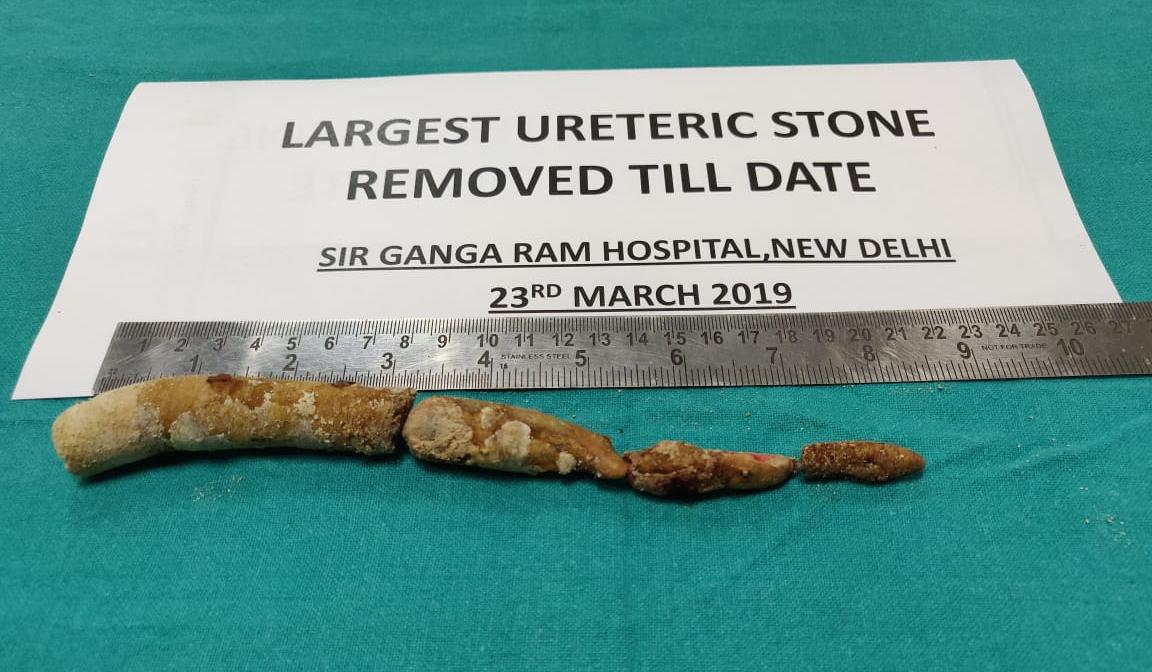
New Delhi [India], Apr 9 (ANI): A team of doctors and a surgery robot named Da Vinci removed the world's largest ureteric stone by surgery on March 23 in Sir Ganga Ram Hospital, here. The stone measured 22 centimetres and weighed 60 grams in total.

ANI Apr 09, 2019 17:10 IST googleads

Largest ureteric stone removed till date at Sir Ganga Ram Hospital, New Delhi

New Delhi [India], Apr 9 (ANI): A team of doctors and a surgery robot named Da Vinci removed the world's largest ureteric stone by surgery on March 23 in Sir Ganga Ram Hospital, here. The stone measured 22 centimetres and weighed 60 grams in total.
In an exclusive interview given to ANI, Dr Sachin Kathuria, consultant, Urology, Sir Ganga Ram Hospital said: "We were surprised to see such a long stone which was covering almost the entire length of the urinary pipe. Using the robot in surgery made it possible for us to remove the stone in one go, otherwise, the patient would have to undergo multiple surgeries."
It is the longest ureteric stone reported to date. The longest ureteric stone removed prior to this was 21.5 centimetres long, according to doctor Kathuria.
The patient named Natasha, a resident of Saharanpur, was admitted in the hospital on March 22 and the operation took place on March 23. The surgery for removing the stone took four hours to complete.
Interestingly, the patient was completely pain-free and unaware of the massive stone that lay inside her body.
Talking further, doctor Kathuria said: "The use of surgical robot made the stone removal possible with a minimum scar and quick recovery for the patient.”
Kidney stones are a very common occurrence in this part of the country. Large stone growth is also not uncommon and they need a multitude of treatment to remove them completely.
The team of doctors namely Dr Sachin Kathuria, Dr Ajay Sharma and Dr Vikram Batra along with the robot. (ANI)

Get the App

What to Read Next

Health

Ageing reduces CAR-T cell effectiveness by impairing metabolism

Ageing reduces CAR-T cell effectiveness by impairing metabolism

People's immune systems deteriorate as they age, making cancer therapies that rely on immune cells difficult to implement. In a new study, researchers from the University of Lausanne (UNIL), the Lausanne University Hospital (CHUV), the Geneva University Hospitals (HUG), and the Ecole Polytechnique Federale de Lausanne (EPFL) show that age-related immune decline has a measurable impact on CAR-T cell therapy, one of the most advanced forms of cancer immunotherapy.

Read More
Health

'Critical relationship between stem cells, mechanical signals'

'Critical relationship between stem cells, mechanical signals'

A new study by The Hospital for Sick Children (SickKids) and the Institut Curie demonstrates how stem cells sense and adapt to their surroundings, with implications for inflammatory bowel disease and colorectal cancer.

Read More
Health

Stimulating hypothalamus restores walking in paralyzed patients

Stimulating hypothalamus restores walking in paralyzed patients

Researchers at EPFL and Lausanne University Hospital (CHUV), led by professors Gregoire Courtine and Jocelyne Bloch, have made significant advances in the treatment of spinal cord injuries (SCI). The scientists boosted the recovery of lower limb movements in two people with partial SCI by delivering deep brain stimulation (DBS) to an unanticipated region of the brain--the lateral hypothalamus (LH), considerably increasing their autonomy and well-being.

Read More
Health

How stress is fundamentally changing our memories, finds study

How stress is fundamentally changing our memories, finds study

Researchers at The Hospital for Sick Children (SickKids) revealed that stress alters how our brain encodes and retrieves aversive memories, and they developed a potential new method for restoring adequate memory specificity in persons suffering from post-traumatic stress disorder (PTSD).

Read More
Health

New technique predicts worsening of chronic kidney disease: Study

New technique predicts worsening of chronic kidney disease: Study

Aarhus University researchers have come up with a new technique that may represent a major advancement in the treatment of chronic renal disease. The technique has the ability to forecast how the illness will evolve, which may guarantee more effective and individualised care and lessen the frequency of hospital stays.

Read More
Home About Us Our Products Advertise Contact Us Terms & Condition Privacy Policy

Copyright © aninews.in | All Rights Reserved.


