

ADD ANI AS A TRUSTED SOURCE
googleads
Menu
Health

Social distancing in airplane seat assignments can reduce COVID-19 spread

Maryland [US], March 28 (ANI): A new research conducted to minimise the risk of secondary infections aboard has used two models to help solve the airplane seating assignment problem because COVID-19 has been shown to spread on airplanes by infected passengers.

ANI Mar 28, 2021 17:06 IST googleads

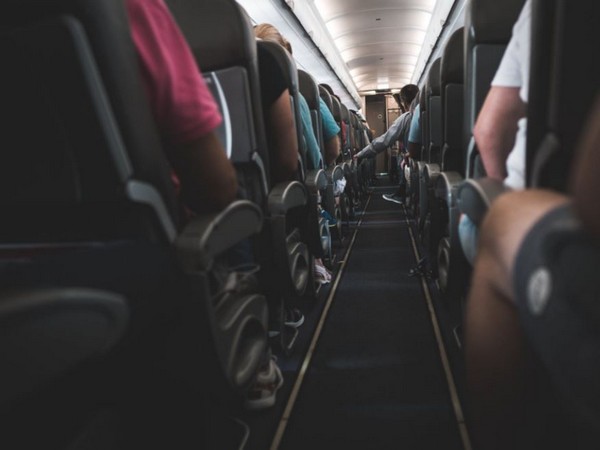
Representative Image

Maryland [US], March 28 (ANI): A new research conducted to minimise the risk of secondary infections aboard has used two models to help solve the airplane seating assignment problem because COVID-19 has been shown to spread on airplanes by infected passengers.
The models can lower the transmission risk of COVID-19 more so than the strategy of blocking the middle seats, given the same number of passengers. The results of the study were published in the INFORMS journal Service Science.
"Blocking the middle seat on an airplane may provide limited benefit in reducing the risk of transmission of COVID-19. Rather, other health protocols are better supported at preventing the transmission of the virus," said Sheldon Jacobson, Founder Professor of computer science at the University of Illinois Urbana-Champaign.
The study, "Airplane Seating Assignment Problem," was conducted by Jacobson, John Pavlik and Ian Ludden, all from the University of Illinois Urbana-Champaign, alongside Edward Sewell from Southern Illinois University Edwardsville.
The researchers introduced two variations of a seating assignment model to optimide how each plane should seat passengers depending on the plane's size and how seats are distributed on the aircraft.
The two models are called vertex packing risk minimization (VPR) and risk-constrained vertex packing (RCV). To determine which to use to solve ASAP, you match the specific airplane being filled using the best-known disease transmission risks, then solve the instance to generate an optimal seating solution.
"Every seat on the airplane corresponds to a single vertex in the graph. Edges between vertices represent the risk of transmitting disease between each pair of seats. If either seat in a pair is empty, then there is no risk of transmitting disease, and hence VPR and RCV are closely related to the vertex packing problem," continued Jacobson.
"Given an undirected graph modeling an airplane seating assignment problem instance with appropriate risks on the edges, the solution to VPR is an optimal configuration of seats to minimize the risk of transmission for a fixed number of passengers on the airplane. Similarly, the solution to RCV is the maximum number of passengers and corresponding seat configuration given a maximum acceptable total risk of transmission." (ANI)


Get the App

What to Read Next

Health

The truth about ‘Eating for Two’ explained by doctors

The truth about ‘Eating for Two’ explained by doctors

Health experts warn that interpreting the advice literally can lead to excessive calorie intake, unhealthy weight gain and a higher risk of Gestational Diabetes Mellitus (GDM), a condition that affects blood sugar levels during pregnancy.

Read More
Health

High-fat keto diet may boost exercise benefits

High-fat keto diet may boost exercise benefits

A new study suggests that eating more fat rather than less could help the body gain greater benefits from exercise when blood sugar levels are high, offering an unexpected perspective on how diet and physical activity work together to support metabolic health.

Read More
Health

Pre-workout supplements may cut sleep in half for young users

Pre-workout supplements may cut sleep in half for young users

A popular fitness trend among young people may be quietly undermining their sleep. A new study led by researchers at the University of Toronto has found that teenagers and young adults who use pre-workout supplements are significantly more likely to experience extremely short sleep durations.

Read More
Health

The more you fear aging, the faster your body may age

The more you fear aging, the faster your body may age

Worrying about getting older especially fearing future health problems may actually speed up aging at the cellular level, according to new research from NYU.

Read More
Health

Scientists reveal how exercise protects brain from Alzheimer's

Scientists reveal how exercise protects brain from Alzheimer's

Exercise may sharpen the mind by repairing the brain's protective shield. Researchers found that physical activity prompts the liver to release an enzyme that removes a harmful protein, causing the blood-brain barrier to become leaky with age.

Read More
Home About Us Our Products Advertise Contact Us Terms & Condition Privacy Policy

Copyright © aninews.in | All Rights Reserved.


