

ADD ANI AS A TRUSTED SOURCE
googleads
ANI Logo
Menu
Health

Scientists develop a new AI breast cancer diagnostic tool

Washington D.C. [USA], Dec 2 (ANI): Scientists are developing a new way to identify the unique chemical 'fingerprints' for different types of breast cancers. These new chemical footprints will be used to train AI (artificial interlligence) software - creating a new tool for rapid and accurate diagnosis of breast cancers.

ANI Dec 02, 2019 23:27 IST googleads

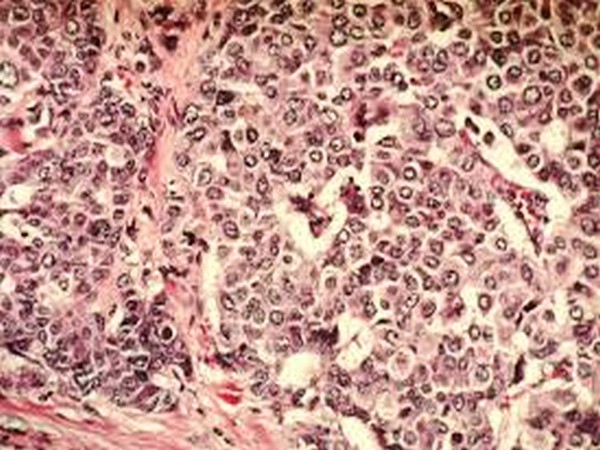
Breast Cancer cells.

Washington D.C. [USA], Dec 2 (ANI): Scientists are developing a new way to identify the unique chemical 'fingerprints' for different types of breast cancers. These new chemical footprints will be used to train AI (artificial interlligence) software - creating a new tool for rapid and accurate diagnosis of breast cancers.
The team of researchers from Lancaster University and Airedale NHS Foundation Trust are using a specialised chemical analytical technique called Raman Spectroscopy on biopsies to identify the molecular structure of different types of breast cancer, as well as variations within each cancer cell group.
The results of the study were publlished in the journal Expert Review of Molecular Diagnostics.
Raman analysis is able to provide real-time information on cells and can be used to check how the cells are behaving, spreading and emerging elsewhere in the body.
After identifying the chemical fingerprints of breast cancer cells, and observing how they change, the researchers used this information to train complex machine learning algorithms to identify four subtypes of cancer.
The algorithms successfully predicted diagnostic patterns for each subtype with a high level of accuracy ranging between 70 per cent and 100 per cent.
Similar versions of these algorithms have previously been used to identify other forms of caners and diseases such as skin, oral and lung cancers.
The next stage of the research will look at creating databases of the chemical structures of many more different types of breast cancer cells and the forms they can take.
These databases will be then used to train more artificial intelligent algorithms using machine learning - eventually leading to a new diagnostic tool to sit alongside mammograms and MRI scans.
The new algorithms promise to provide rapid information to help medical specialists to make quicker diagnosis.
In addition, the approach will help to determine the state of the disease at various points in its progression and will become critical in planning the therapeutic approach of individual patients.
Professor Ihtesham Rehman, Chair in Bioengineering at Lancaster University and senior author of the study, said: "This research is an important step in developing a new way to identify the chemical structures of different types of breast cancers. We have been able to use these 'fingerprints' to develop complex algorithms that are accurately able to identify cells of four different types of cancer types.
"Vibrational spectroscopy combined with data mining and machine learning has the potential to offer a real-time analysis in biological samples, including cancer, with excellent accuracy - creating a powerful new tool to sit alongside existing techniques and helping medical specialists deliver accurate and timely diagnosis for their patients, and for monitoring the progression of the disease." (ANI)

Get the App

What to Read Next

Health

Scientists discover reason high altitude protects against diabete

Scientists discover reason high altitude protects against diabete

Living at high altitude appears to protect against diabetes, and scientists have finally discovered the reason. When oxygen levels drop, red blood cells switch into a new metabolic mode and absorb large amounts of glucose from the blood.

Read More
Health

Scientists solve a major roadblock in cancer cell therapy: Study 

Scientists solve a major roadblock in cancer cell therapy: Study 

Researchers have found a reliable way to grow helper T cells from stem cells, solving a major challenge in immune-based cancer therapy. Helper T cells act as the immune system's coordinators, helping other immune cells fight longer and harder.

Read More
Health

Injection turns sleeping tumour immune cells into cancer fighters

Injection turns sleeping tumour immune cells into cancer fighters

The Korea Advanced Institute of Science and Technology (KAIST) researchers have developed a way to reprogram immune cells already inside tumours into cancer-killing machines.

Read More
Health

Scientists found a way to help ageing guts heal themselves

Scientists found a way to help ageing guts heal themselves

Researchers have discovered a way to help aging intestines heal themselves using CAR T-cell therapy. By targeting senescent cells that build up over time, the treatment boosted gut regeneration, reduced inflammation, and improved nutrient absorption in mice.

Read More
Health

High-fat diets give liver cancer a dangerous head start: Study

High-fat diets give liver cancer a dangerous head start: Study

A high-fat diet does more than overload the liver with fat. New research from MIT shows that prolonged exposure to fatty foods can push liver cells into a survival mode that quietly raises the risk of cancer.

Read More
Health

Researchers have decoded rare cancer fighting plant compound

Researchers have decoded rare cancer fighting plant compound

UBC Okanagan researchers have uncovered how plants create mitraphylline, a rare natural compound linked to anti-cancer effects.

Read More
Health

Air pollution may reduce health benefits of exercise: Study

Air pollution may reduce health benefits of exercise: Study

A new study led by researchers at University College London (UCL) shows that chronic exposure to toxic air can significantly diminish the health benefits of regular physical activity.

Read More
Health

Iimmune cells use surprising trick to heal muscle faster: Study

Iimmune cells use surprising trick to heal muscle faster: Study

A research team has found that specific immune cells can connect with muscle fibres in a lightning-fast, neuron-like way to promote healing.

Read More
Health

Blocking a single protein forces cancer cells to self-destruct

Blocking a single protein forces cancer cells to self-destruct

Researchers uncovered a powerful weakness in lung cancer by shutting down a protein that helps tumours survive stress.

Read More
Health

Hypertension affects brain much earlier than expected: Study

Hypertension affects brain much earlier than expected: Study

Hypertension may impair the brain far earlier than previously understood -- even before a measurable rise in blood pressure occurs -- according to a new preclinical study from Weill Cornell Medicine. The changes help explain why hypertension is a major risk factor for developing cognitive disorders, such as vascular cognitive impairment and Alzheimer's disease.

Read More
Home About Us Our Products Advertise Contact Us Terms & Condition Privacy Policy

Copyright © aninews.in | All Rights Reserved.




