

ADD ANI AS A TRUSTED SOURCE
googleads
ANI Logo
Menu
Health

How people type and click can detect their stress at work: Study

Researchers at ETH Zurich have used new data and machine learning to develop a model that can tell how stressed people are just from the way they type and use a computer mouse

ANI Apr 18, 2023 19:48 IST googleads

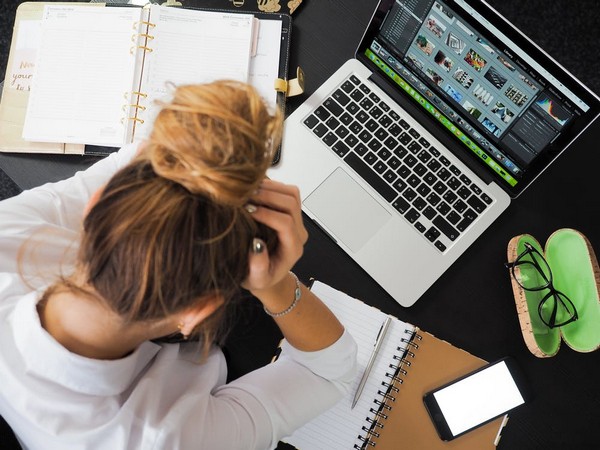
Representative Image

Zurich [Switzerland], April 18 (ANI): Researchers at ETH Zurich have used new data and machine learning to develop a model that can tell how stressed people are just from the way they type and use a computer mouse.
And there's more: "How we type on our keyboard and move our mouse seems to be a better predictor of how stressed we feel in an office environment than our heart rate," explains study author Mara Nagelin, a mathematician who conducts research at the Chair of Technology Marketing and the Mobiliar Lab for Analytics at ETH Zurich. Applied correctly, these findings could be used in future to prevent increased stress in the workplace early on.
Stressed people type and click differently
The ETH researchers proved in an experiment that stressed people type and move their mouse differently from relaxed people. "People who are stressed move the mouse pointer more often and less precisely and cover longer distances on the screen. Relaxed people, on the other hand, take shorter, more direct routes to reach their destination and take more time doing so," Nagelin says.
What's more, people who feel stressed in the office make more mistakes when typing. They write in fits and starts with many brief pauses. Relaxed people take fewer but longer pauses when typing on a keyboard.
The connection between stress and our typing and mouse behaviour can be explained with what is known as neuromotor noise theory: "Increased levels of stress negatively impact our brain's ability to process information. This also affects our motor skills," explains psychologist Jasmine Kerr, who researches with Nagelin and is a coauthor of the study.
Simulating office stress as realistically as possible
To develop their stress model, the ETH researchers observed 90 study participants in the lab performing office tasks that were as close to reality as possible, such as planning appointments or recording and analysing data. They recorded the participants' mouse and keyboard behaviour as well as their heart rates. In addition, the researchers asked the participants several times during the experiment how stressed they felt.
While some participants were allowed to work undisturbed, others also had to take part in a job interview. Half of this group were also repeatedly interrupted with chat messages. In contrast to earlier studies by other scientists, where the control group often did not have to solve any tasks at all and could relax, in the ETH researchers' experiment, all participants had to perform the office tasks.
"We were surprised that typing and mouse behaviour was a better predictor of how stressed subjects felt better than heart rate," Nagelin says. She explains that this is because the heart rates of the participants in the two groups did not differ as much as in other studies. One possible reason is that the control group was also given activities to perform, which is more in line with workplace reality.
Data must be protected
The researchers are currently testing their model with data from Swiss employees who have agreed to have their mouse and keyboard behaviour as well as their heart data recorded directly at their workplace using an app. The same app also regularly asks the employees about their subjective stress levels. Results should be available by the end of the year.
However, workplace stress detection also raises some thorny issues: "The only way people will accept and use our technology is if we can guarantee that we will anonymize and protect their data. We want to help workers to identify stress early, not create a monitoring tool for companies," Kerr says. In another study involving employees and ethicists, the researchers are investigating which features an app needs to have to meet these requirements and ensure responsible handling of sensitive data. (ANI)


Get the App

What to Read Next

Health

The truth about ‘Eating for Two’ explained by doctors

The truth about ‘Eating for Two’ explained by doctors

Health experts warn that interpreting the advice literally can lead to excessive calorie intake, unhealthy weight gain and a higher risk of Gestational Diabetes Mellitus (GDM), a condition that affects blood sugar levels during pregnancy.

Read More
Health

Pre-workout supplements may cut sleep in half for young users

Pre-workout supplements may cut sleep in half for young users

A popular fitness trend among young people may be quietly undermining their sleep. A new study led by researchers at the University of Toronto has found that teenagers and young adults who use pre-workout supplements are significantly more likely to experience extremely short sleep durations.

Read More
Health

The more you fear aging, the faster your body may age

The more you fear aging, the faster your body may age

Worrying about getting older especially fearing future health problems may actually speed up aging at the cellular level, according to new research from NYU.

Read More
Health

Scientists discover reason high altitude protects against diabete

Scientists discover reason high altitude protects against diabete

Living at high altitude appears to protect against diabetes, and scientists have finally discovered the reason. When oxygen levels drop, red blood cells switch into a new metabolic mode and absorb large amounts of glucose from the blood.

Read More
Health

Scientists find clue to human brain evolution in finger length

Scientists find clue to human brain evolution in finger length

Human evolution has long been tied to growing brain size, and new research suggests prenatal hormones may have played a surprising role. By studying the relative lengths of the index and ring fingers, a marker of prenatal exposure to oestrogen and testosterone, researchers found that higher prenatal oestrogen exposure was associated with larger head size in newborn boys.

Read More
Health

MRI scans show exercise can make the brain look younger

MRI scans show exercise can make the brain look younger

New research suggests that consistent aerobic exercise can help keep your brain biologically younger. Adults who exercised regularly for a year showed brains that appeared nearly a year younger than those who didn't change their habits.

Read More
Health

Scientists find hidden synapse hotspots in the teen brain: Study

Scientists find hidden synapse hotspots in the teen brain: Study

The scientists have discovered that the adolescent brain does more than prune old connections. During the teen years, it actively builds dense new clusters of synapses in specific parts of neurons.

Read More
Health

Injection turns sleeping tumour immune cells into cancer fighters

Injection turns sleeping tumour immune cells into cancer fighters

The Korea Advanced Institute of Science and Technology (KAIST) researchers have developed a way to reprogram immune cells already inside tumours into cancer-killing machines.

Read More
Health

Scientists found a way to help ageing guts heal themselves

Scientists found a way to help ageing guts heal themselves

Researchers have discovered a way to help aging intestines heal themselves using CAR T-cell therapy. By targeting senescent cells that build up over time, the treatment boosted gut regeneration, reduced inflammation, and improved nutrient absorption in mice.

Read More
Health

High-fat diets give liver cancer a dangerous head start: Study

High-fat diets give liver cancer a dangerous head start: Study

A high-fat diet does more than overload the liver with fat. New research from MIT shows that prolonged exposure to fatty foods can push liver cells into a survival mode that quietly raises the risk of cancer.

Read More
Home About Us Our Products Advertise Contact Us Terms & Condition Privacy Policy

Copyright © aninews.in | All Rights Reserved.


