 हिंदी खबर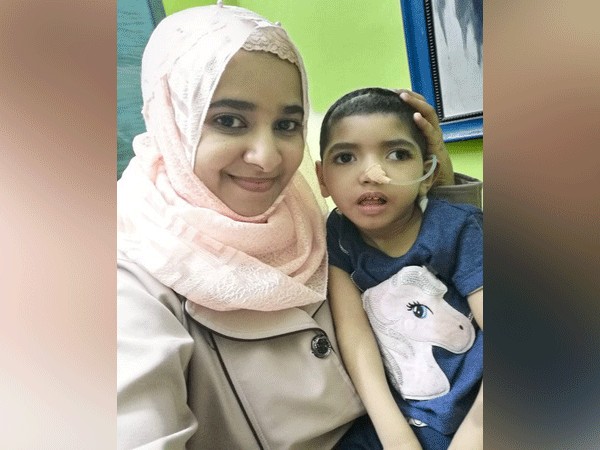

New Delhi [India], Sep 22 (ANI): A four-and-half-year old girl from Yemen suffering from a rare kind of epilepsy has received a fresh lease of life thanks to doctors at the premier All India Insititute of Medical Sciences here.
Manar Fahd Ahmed was born 33-year-old Noora Ahmed Othman Thabit whose house was destroyed in the ongoing civil war in Yemen.
Right from birth Manar was different according to her mother. "She never cried nor did she many any noise like other children kids of her age," said Noora.
When Manar was eight months old, Noora said she had doubts that her daughter had some kind of problem, which were confirmed when the baby started to have seizures that amounted to 100 or more every day.
Fighting against all odds in Sanaa, the capital of Yemen, Noora somehow reached India in April this year through a medical visa for her child's treatment at a private hospital in Mumbai.
Doctors at the Mumbai hospital virtually wrote her child off and said there was no treatment for her daughter because of the complexity of her case.
The young mother said she was struggling since she did not know how to speak Hindi nor did she have any relatives in India. She said she could only manage to communicate using broken English.
"I didn't lose hope and kept on searching for good hospitals in India. After months of struggle and stay in Mumbai, I learnt that AIIMS in Delhi can possibly treat my daughter."
"When I met doctors here at the neurosurgery department, they assured me that Manar's uncontrollable seizures can be stopped and she could cry and make noise like other children," she said.
When baby Manar reached AIIMS, she was investigated by the team of Dr Manjari Tripathi, professor of Neurology who performed an MRI and a video EEG followed by Magnetoencephlography.
This was followed by a detailed discussion with the team of epilepsy surgery team and decision was taken to provide a minimal invasive endoscopic corpus callotomy along with commisural section surgery which was led by Dr Sarat P Chandra, Professor of Neurosurgery at AIIMS.
"The baby was having a difficult time. She had a rare kind of syndrome that caused epilepsy due to severe brain damage. And since the child was very small, it was unlikely to sustain an open surgery," Dr Chandra said.
Summarising the procedure, the doctor said it involved a complete disconnection between the two hemispheres of the brain, which in lay terms was similar to bombing a major highway that halts the traffic completely, in this case being transmission of epilepsy.
The Professor said the surgical team decided to do a minimal invasive endoscopic Corpus Callostomy along with anterior, middle and posterior commisurotomy.
"This is a unique technique which we have developed and published in 'Neurosurgery', which is the official journal of the Congress of Neuro Surgeons of USA (CNS)," Dr Chandra told ANI.
He further added that the procedure disconnects complete connection between the two hemispheres this preventing the generalization of seizures.
"Unlike a corpus callotomy alone, additional sectioning of commisural leads to better disconnection and this technique showed promising results in children with uncontrolled bi-hemispheric epilepsy," he said.
"By introducing endoscopy, we did a 3 cm-4 cm opening, with hardly any blood loss. We passed an endoscope which was guided by a robot between the two hemisphere and we cut the Corpus callosum and also the commissure. These are fundamentally connections which join and pass electrical connections between both brains. It's like bombing a major highway which stops the traffic completely in this case being transmission of epilepsy"
"When we did this, there was complete dis-connection between the two hemispheres. And this connection was leading to the spread of seizures from one part of the brain to the other."
Doctors say that primarily, this kind of technique is performed on children.
"Post operative pain is very less and no blood loss because this was a minimal invasive surgery," he said.
Noora, a shy and soft-spoken woman said she is happy with the development and is grateful to the doctors.
"Post surgery, Manar is doing well. Now she cries and makes noises. Her seizures have completly stopped. But she has become weak post operation, which doctors have said will gradually improve with time," says Noora
Talking about the situation in her country Noora said the consequences of war are terrible for ordinary people.
"There are no good doctors and hospitals in Yemen. This ongoing war has disrupted water and food supply system in my country. Many expecting mothers are experiencing complications in childbirth and parents of sick children are unable to reach medical care in Yemen in a safe and quick time," she said. (ANI)
Yemeni child with severe epilepsy finds new life at AIIMS
By Priyanka Sharma | Updated: Sep 22, 2019 13:46 IST


