

ADD ANI AS A TRUSTED SOURCE
googleads
ANI Logo
Menu
Health

Acute itching in eczema patients linked to environmental allergens

Washington [US], January 15 (ANI): New research from Washington University School of Medicine in St. Louis indicates that allergens in the environment often are to blame for episodes of acute itch in eczema patients.

ANI Jan 15, 2021 11:25 IST googleads

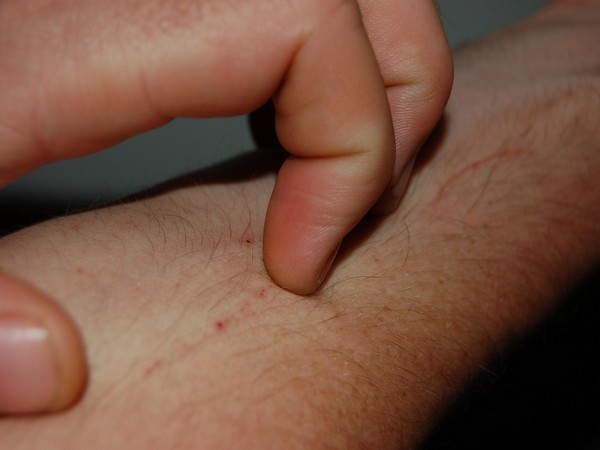
Representative image

Washington [US], January 15 (ANI): New research from Washington University School of Medicine in St. Louis indicates that allergens in the environment often are to blame for episodes of acute itch in eczema patients.
It further indicates that the itching often doesn't respond to antihistamines because the itch signals are being carried to the brain along a previously unrecognized pathway that current drugs don't target.
The new findings, published in the journal Cell, point to a possible new target and strategy to help eczema patients cope with those episodes of acute, severe itch.
"Years ago, we used to think that itch and pain were carried along the same subway lines in the nerves to the brain, but it turned out they weren't, and these new findings show there's another pathway entirely that's causing these episodes of acute itching in eczema patients," said principal investigator Brian S. Kim, MD, a dermatologist and an associate professor of medicine.
"The itch can be maddening. Patients may rate their chronic itch at around a 5 on a scale of 10, but that goes up to 10 during acute itch flares. Now that we know those acute flares are being transmitted in an entirely different way, we can target that pathway, and maybe we can help those patients," added Kim.
The typical pathway for itching in eczema patients involves cells in the skin that are activated and then release histamine, which can be inhibited with antihistamine drugs. But with this acute itching, a different type of cell in the bloodstream transmits itch signals to the nerves.
Those cells produce too much of another non-histamine substance that triggers itch; therefore, antihistamines don't work in response to such signals.
"We've connected acute itching in eczema to allergic reactions transmitted by an entirely different population of cells," said Kim, also the co-director of the Center for the Study of Itch & Sensory Disorders.
"In patients who experience episodes of acute itching, their bodies react in the same way as in people with acute allergy. If we can block this pathway with drugs, it might represent a strategy for treating not only itch but other problems, including perhaps hay fever and asthma," added Kim.
In recent years, several clinical studies have tested a strategy that involves blocking Immunoglobulin E (IgE), a substance produced by the immune system in response to allergens. Patients with allergies produce IgE, causing allergic reactions, but its role in itch has been unclear.
Reviewing data from clinical studies of drugs aimed at treating chronic itching, Kim found a pattern in which patients reported episodes of acute itching, often after exposure to allergens">environmental allergens.
He also found that eczema patients who make IgE in response to allergens in the environment were more likely to experience those episodes of severe, acute itch.
"Environmental allergens actually promote this type of itch. Say a patient with eczema goes to Grandma's house, where there's a cat, and that person's itching just goes crazy. It's likely cat dander is activating IgE, and IgE is activating itch," he said.
Kim's team took these observations to the laboratory, where his team made a mouse model of eczema. Studying the animals, they found that when the mice made IgE, they began to itch. But unlike standard itch signals, in which cells in the skin called mast cells release histamine, the IgE in mice with eczema activated a type of white blood cell called a basophil.
Those cells then activated an entirely different set of nerve cells than the cells that carry itch signals that respond to antihistamines.
The discovery that acute itching in eczema is linked to exposure to allergens may help them avoid things that make them itch intensely, including animals, dust, mold or certain foods.
Meanwhile, it also offers drug companies new targets for treating itch in eczema patients, including proteins and molecules Kim's team has identified along this newly identified neuro-immune pathway. (ANI)


Get the App

What to Read Next

Health

Lifestyle, Environmental factors affect health and ageing: Study

Lifestyle, Environmental factors affect health and ageing: Study

A new study led by researchers from Oxford Population Health has shown that a variety of environmental factors, including lifestyle choices (such as smoking and physical activity) and living conditions, have a more significant impact on health and premature death than our genes.

Read More
Health

Pregnant women should try to avoid ultraprocessed, fast foods

Pregnant women should try to avoid ultraprocessed, fast foods

According to a study published in the journal Environmental International, pregnant women should think twice before eating a cheeseburger or a boxed pastry. Surprisingly, the report focuses not on the food itself, such as fries, burgers, shakes, and cakes, but on what comes into contact with the meal before it is consumed.

Read More
Health

Study gives insight into neurodevelopmental disease in children

Study gives insight into neurodevelopmental disease in children

Predicting the development of neurodevelopmental and psychiatric illnesses such as autism or schizophrenia is challenging since they are influenced by a wide range of hereditary and environmental factors

Read More
Health

Pregnant women should avoid ultraprocessed, fast foods: Study

Pregnant women should avoid ultraprocessed, fast foods: Study

According to a study published in the journal Environmental International, if you're pregnant, you should think twice before running out to get a cheeseburger or grabbing for a packaged pastry

Read More
Health

Study reveals how viral infections interact with human bodies

Study reveals how viral infections interact with human bodies

Much of our understanding of viral respiratory illnesses such as COVID-19 and influenza is based on investigations of symptomatic patients. A new longitudinal study of symptomatic, asymptomatic, and mild illnesses conducted by Columbia University researchers gives information on how our bodies respond to these infections at the molecular level.

Read More
Health

Exposure to pollutants may reduce chance of getting pregnant

Exposure to pollutants may reduce chance of getting pregnant

According to a study conducted by an environmental and reproductive epidemiologist at the University of Massachusetts Amherst, exposure to phthalates, a group of plasticizing and solvent compounds found in many household objects, was connected with a lower risk of becoming pregnant but not with pregnancy loss.

Read More
Health

Exposure to household chemical may lower odds of getting pregnant

Exposure to household chemical may lower odds of getting pregnant

According to research by a University of Massachusetts Amherst environmental and reproductive epidemiologist, exposure to phthalates, a collection of plasticizing and solvent chemicals found in many home items, was associated with a lower likelihood of getting pregnant but not to pregnancy loss.

Read More
Health

AI creates proteins with high binding strengths

AI creates proteins with high binding strengths

Scientists at the Institute for Protein Design at the University of Washington School of Medicine employed software to design protein molecules with unusually high affinity and specificity to a number of complex indicators, including human hormones. Notably, the scientists obtained the strongest ever documented contact strength between a computer-generated biomolecule and its target.

Read More
Health

Workaholics feel sick even when they are working: Study

Workaholics feel sick even when they are working: Study

Workaholics' moods are often worse than others, even while they are engaged in what they are most enthusiastic about: their work. Workaholism is similar to other types of addictions such as gambling and alcoholism.

Read More
Health

Workaholics feel ill even when they are working: Study

Workaholics feel ill even when they are working: Study

Workaholics' moods are generally worse than those of other people, even while they are engaged in the thing that they are most passionate about; their work. Workaholism is similar to other addictions such as gambling or alcoholism.

Read More
Home About Us Our Products Advertise Contact Us Terms & Condition Privacy Policy

Copyright © aninews.in | All Rights Reserved.
