Wide use of digital currencies in cross-border payments to be credit negative for banks: Moody's
Singapore, Sep 13 (ANI): Wide adoption of central bank digital currencies (CBDCs) in cross-border payments and settlements will be credit negative for banks because of lower fees and commissions, Moody's Investors Service said on Monday.
ANI
Sep 13, 2021 13:19 IST

Singapore, Sep 13 (ANI): Wide adoption of central bank digital currencies (CBDCs) in cross-border payments and settlements will be credit negative for banks because of lower fees and commissions, Moody's Investors Service said on Monday.
This is particularly for those banks that are active in foreign-currency payments, clearing and remittances, it said in its latest credit outlook report.
It is the first time that the Bank of International Settlements (BIS) and various central banks are testing multiple CBDCs in a single platform for cross-border settlements.
This is an important step if CBDCs are to be adopted beyond domestic transactions. Earlier in 2021, the Singaporean and French central banks successfully tested dual-CBDC cross-border transactions, said Moody's.
On September 3, the BIS together with central banks of Singapore, Australia, Malaysia and South Africa started testing CBDCs for cross-border settlements.
The project called Dunbar aims to build a prototype platform for settlement in multiple CBDCs with the target being faster, cheaper and more secure cross-border payments and settlements between financial institutions.
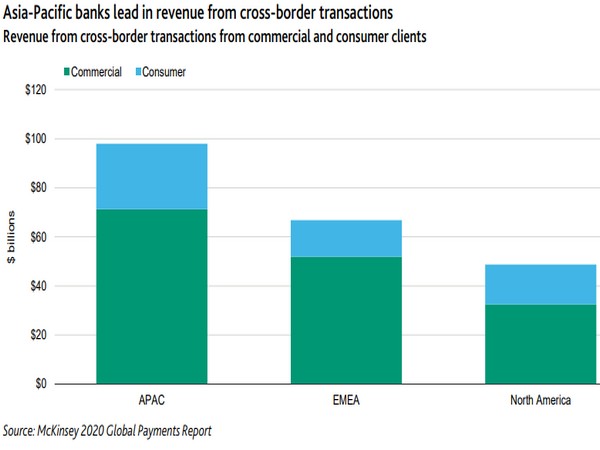
Moody's said the revenue that banks generate from cross-border transactions is significant. Globally, banks generated about 230 billion dollars in revenue from cross-border transactions in 2019, based on data from consulting firm McKinsey.
Banks in Asia Pacific made up 100 billion dollars of this amount, the largest share globally, with most revenue coming from commercial transactions such as bank-to-bank.
According to McKinsey, banks globally generated about 60 billion dollars in revenue in consumer business in 2019 for cross-border transactions such as remittances, where the banks charge hefty fees.
Banks on average charge 6.4 per cent on outward remittances, based on World Bank data, with Nigerian, South African and Thai banks charging some of the highest fees globally. These fees will be reduced with the wider adoption of CBDCs.
It is uncertain if the platform prototypes developed under the Dunbar project will be adopted by other central banks. However, the BIS expects that the results of this project will guide the development of global and regional platforms for more efficient cross-border payments. (ANI)
Tags:
Get the App