Water Transversality Emerges as a Global Imperative
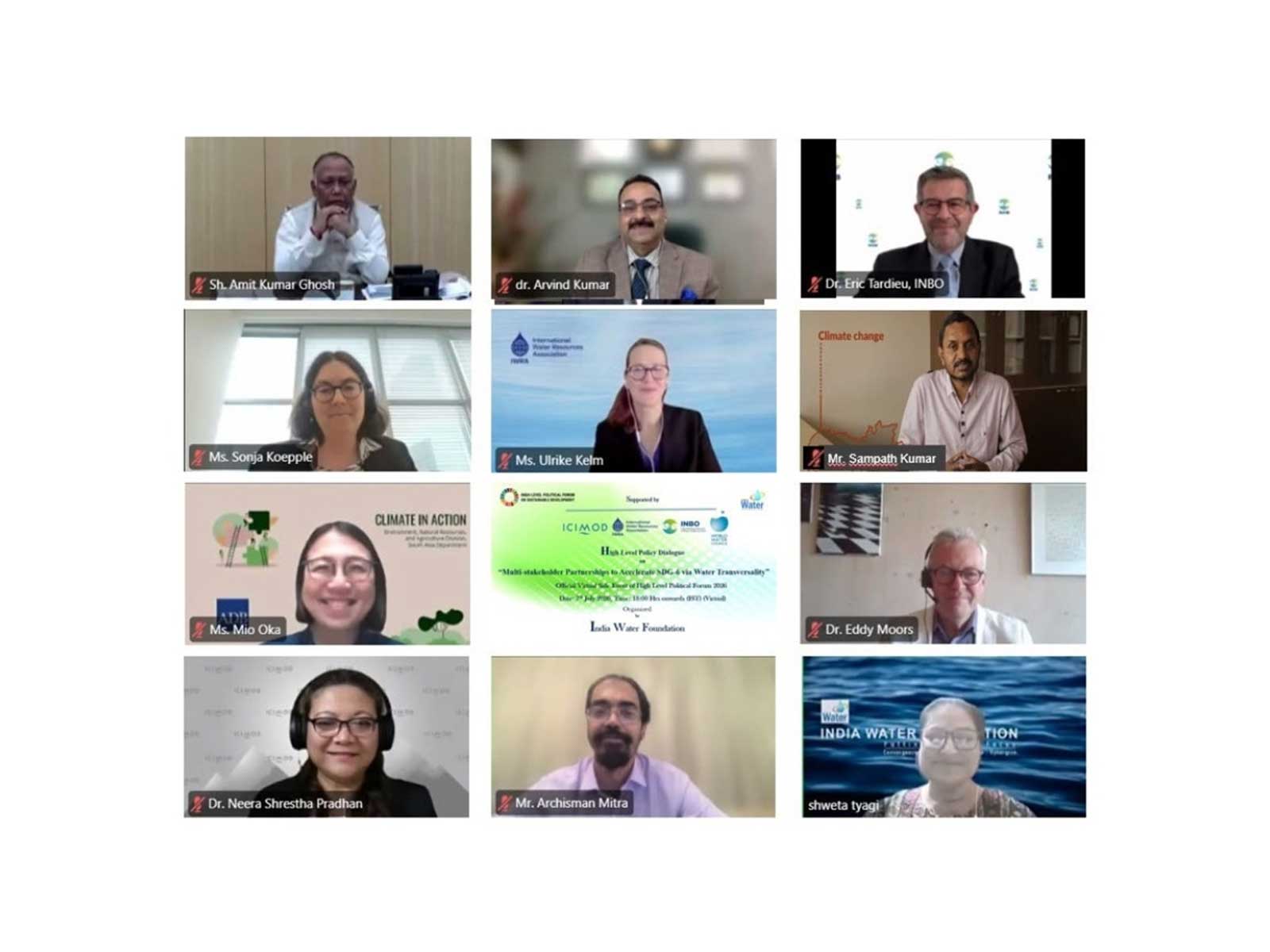
New Delhi [India], July 8: A rallying cry against fragmented water governance was sounded at a high-level policy dialogue on "Multi-Stakeholder Partnerships to Accelerate SDG 6 via Water Transversality," convened virtually on July 7, 2026 as an official side event of the High-Level Political Forum (HLPF) 2026. The dialogue was organised by the India Water Foundation, with support extended by ICIMOD, the International Water Resources Association, the International Network of Basin Organizations, and the World Water Council.
ANI
Jul 08, 2026 16:27 IST

PNN
New Delhi [India], July 8: A rallying cry against fragmented water governance was sounded at a high-level policy dialogue on "Multi-Stakeholder Partnerships to Accelerate SDG 6 via Water Transversality," convened virtually on July 7, 2026 as an official side event of the High-Level Political Forum (HLPF) 2026. The dialogue was organised by the India Water Foundation, with support extended by ICIMOD, the International Water Resources Association, the International Network of Basin Organizations, and the World Water Council.
Proceedings were opened and moderated by Ms. Shweta Tyagi, Chief Functionary, India Water Foundation, who framed uneven progress on SDG 6 as rooted in fragmented ministries, financing and policy processes. Water was declared the invisible thread and "operating system" of sustainable development by Dr. Arvind Kumar, President, India Water Foundation, who urged it be reframed as economic infrastructure, a geopolitical bridge, and a matter of social justice.
Water was described as medicine, prevention and dignity by Sh. Amit Kumar Ghosh, Additional Chief Secretary, Government of Uttar Pradesh, who linked the state's public health strategy to India's national One Health Mission. It was disclosed by Ms. Sonja Koeppel, Secretary to the UNECE Water Convention, United Nations Economic Commission for Europe, that only 43 of 153 countries sharing transboundary waters have operational cooperation arrangements in place, underscoring the need for institutionalised, inclusive governance.
Water considerations were reported to be embedded across agriculture, cities and ecosystems by Ms. Mio Oka, Country Director, India Resident Mission, Asian Development Bank, who called for innovative and private finance to make transversality bankable. River-basin authorities were positioned as natural accelerators of SDG 6 by Dr. Eric Tardieu, Director General, International Office for Water; Secretary General, International Network of Basin Organizations; and Vice President, World Water Council, who also called for integrated water resources management, inclusive governance, shared information systems and cross-border cooperation to be mainstreamed into water planning.
A landscape-based, community-anchored model, underpinned by a new Payment for Ecosystem Services policy, was credited with reversing water scarcity in Meghalaya by Mr. Sampath Kumar, Additional Chief Secretary, Government of Meghalaya, and CEO, Meghalaya Basin Development Authority. Education was called the "bedrock of informed citizenship" by Dr. Eddy Moors, Former Rector, IHE Delft Institute for Water Education, who warned that climate and water themes remain largely absent from school curricula worldwide asserting that long-term water security cannot be achieved without investing equally in people alongside infrastructure.
Water was hailed as "the connector" underpinning all 17SDGs by Ms. Ulrike Kelm, Deputy Executive Director, International Water Resources Association, who cautioned that water remains "under fire" from pollution, over-abstraction and conflict. Transversality was urged to extend vertically, from glaciers to oceans, by Dr. Neera Shrestha Pradhan, Water and DRR Lead, ICIMOD, who insisted that disaster risk reduction and disaggregated, mountain-inclusive data be treated as core pillars rather than afterthoughts. Community ownership, private capital mobilisation and systematic water accounting were identified as the three actionable levers for moving transversality from principle to practice by Mr. Archisman Mitra, Senior Water Economist, World Bank.
Several converging outcomes were recorded. It was agreed that water can no longer be planned in isolation, and must be mainstreamed as economic infrastructure, a geopolitical bridge and a social-justice imperative across ministries and investment frameworks. Cross-sectoral partnerships spanning governments, basin authorities, multilateral banks, philanthropy, academia and communities were identified as indispensable to closing the sector's financing gap, estimated at over 100 billion dollars annually. Disaster risk reduction, disaggregated data, education and community ownership were called upon to be embedded as core pillars of implementation, not peripheral add-ons. Participants were urged to carry this integrated agenda to the 2026 UN Water Conference, where it was proposed that ministries of education, finance and water be brought to a shared table for the first time.
The dialogue was closed with calls for stable regulatory and institutional environments, decentralised wastewater treatment, climate-smart agriculture, and deeper scientific and data collaboration to be prioritised as the global water community moves from commitment to implementation in the final stretch to 2030 and also setting a precedent for 2026 UN Water Conference.
(ADVERTORIAL DISCLAIMER: The above press release has been provided by PNN. ANI will not be responsible in any way for the content of the same.)
Tags:
Get the App