Union govt is measuring to increase blending of ethanol in petrol beyond 20 pc from 2030
The National Policy on Biofuels - 2018, as amended in 2022, inter-alia advanced the target of 20 per cent blending of ethanol in petrol to Ethanol Supply Year (ESY) 2025-26 from 2030.
ANI
Mar 20, 2025 17:06 IST

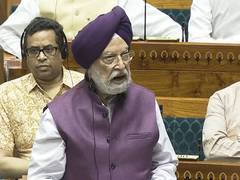
New Delhi, India, March 20 (ANI): The Union government is planning to increase the blending of 20 per cent ethanol in petrol from 2030, Union Minister of State for Tourism and Petroleum Suresh Gopi said in a written reply to the Lok Sabha on Thursday.
The National Policy on Biofuels - 2018, as amended in 2022, inter-alia advanced the target of 20 per cent blending of ethanol in petrol to Ethanol Supply Year (ESY) 2025-26 from 2030.
Public Sector Oil Marketing Companies (OMCs) achieved the target of 10 per cent ethanol blending in petrol in June 2022 i.e. five months ahead of the target during ESY 2021-22. The blending of ethanol further increased to 12.06 per cent in ESY 2022-23, 14.60 per cent in ESY 2023-24 and 17.98 per cent in ESY 2024-25 upto 28th February 2025.
So far, the government has not decided to increase ethanol blending beyond 20 per cent, according to a release by the Ministry of Petroleum & Natural Gas that quotes the MoS.
According to the Roadmap for Ethanol Blending in India 2020-25, prepared by an inter-ministerial committee, using 20 per cent ethanol-blended petrol (E20) results in marginal reduction in fuel efficiency for four-wheelers designed for E10 and calibrated for E20.
The Society of Indian Automobile Manufacturers (SIAM) informed the committee that engine hardware and tuning modifications can reduce the efficiency loss due to blended fuel.
As per the MoS reply, the committee report has also highlighted that no major issues were observed in vehicle performance, wear of engine components, or engine oil deterioration with E20 fuel.
The National Policy on Biofuels permits the use of food grains during the surplus phase, as declared by the National Biofuel Coordination Committee.
This Policy also promotes and encourages the use of feedstock such as corn, cassava, rotten potatoes, damaged food grains like broken rice, food grains unfit for human consumption, maize, sugarcane juice and molasses, and agriculture residues (Rice straw, cotton stalk, corn cobs, sawdust, bagasse, etc.).
The extent of utilization of individual feedstock for ethanol production varies annually, influenced by factors such as availability, costs, economic feasibility, market demand, and policy incentives.
Any diversion of sugarcane juice, its by-products, maize, etc., for ethanol production is carefully calibrated in consultation with relevant stakeholders.
Further, the Government has taken several measures since 2014 to encourage farmers and ethanol producers to scale up production under the EBP Programme.
The EBP programme includes expanding feedstock for ethanol production, implementing an administered price mechanism for the procurement of ethanol under the EBP Programme, lowering the GST rate to 5 per cent on ethanol for the EBP Programme, amending the Industries (Development and Regulation) Act to facilitate intrastate and interstate movement of ethanol, simplifying the ethanol procurement process by Public Sector Oil Marketing Companies (OMCs), and advancing the target for 20 per cent ethanol blending in petrol to the Ethanol Supply Year (ESY) 2025-26 from 2030.
Additionally, during 2018-22, the Government introduced various Ethanol Interest Subsidy Schemes (EISS) to establish ethanol plants and produce ethanol from molasses and grains.
Long Term Offtake Agreements (LTOAs) were also signed by OMCs with Dedicated Ethanol Plants (DEPs). (ANI)
Get the App