Singapore's Digital Economy at 18.6% of GDP, up from 14.9% in 2019; Growth fuelled by accelerating digitalisation and AI adoption across sectors and firms
Singapore, October 6: Digitalisation is essential to the growth of Singapore's overall economy. In 2024, Singapore's digital economy grew by S$12 billion[1], expanding to a total of S$128.1 billion. This accounts for 18.6% of the nation's gross domestic product (GDP), up from 18.0% in 2023 and 14.9% in 2019. Pulse survey conducted by IMDA unveiled 3 in 4 workers are using AI tools regularly, with 85% of the AI-using workers polled finding that AI helps them to work faster and better. SMEs' AI adoption rate more than tripled in just one year: 14.5% of SMEs and 62.5% of non-SMEs adopted AI in 2024.
ANI
Oct 06, 2025 14:41 IST


PRNewswire
Singapore, October 6: Digitalisation is essential to the growth of Singapore's overall economy. In 2024, Singapore's digital economy grew by S$12 billion[1], expanding to a total of S$128.1 billion. This accounts for 18.6% of the nation's gross domestic product (GDP), up from 18.0% in 2023 and 14.9% in 2019. Pulse survey conducted by IMDA unveiled 3 in 4 workers are using AI tools regularly, with 85% of the AI-using workers polled finding that AI helps them to work faster and better. SMEs' AI adoption rate more than tripled in just one year: 14.5% of SMEs and 62.5% of non-SMEs adopted AI in 2024.
According to IMDA's Singapore Digital Economy (SGDE) Report 2025, more than two-thirds of Singapore's digital economy came from non-Information & Communications (I&C) sectors. This shows that Singapore's digital growth is not just driven by tech companies, but by digitalisation across all industries. Among these non-I&C sectors, Finance & Insurance remained the largest contributor, followed by Wholesale Trade, and Manufacturing, underscoring the critical need for all enterprises -- regardless of industry -- to embrace digitalisation to drive growth.
Digitalisation Benefits All Firms, with 95% of SMEs onboard
According to the report, enterprises are making digitalisation central to how they operate. In 2024, the digital adoption rate[2] rose. 95.1% of SMEs have adopted at least one digital area out of the six[3] measured.
SMEs are leading the charge in deepening digitalisation, and this is evident in several ways:
a. Their digital adoption intensity[4] saw the largest jump in years, with SMEs using an average of 2.3 digital areas of the six measured, up from 2.0 in 2023.
b. The adoption of sector-specific digital solutions[5], as recommended in IMDA's Industry Digital Plans (IDPs)[6], also increased considerably. Almost all (97%) SMEs adopted at least one sector-specific solution, up from just 85% the year before.
Tech Workforce Expands, Offering Strong Prospects Beyond I&C sectors
Singapore's tech workforce continued to expand from 208,300 in 2023 to 214,000 in 2024, with roles related to AI & Data and Cybersecurity among the fastest growing. This growth was primarily driven by non-I&C sectors, reflecting the deepening of digitalisation across the economy.
Tech jobs also continue to offer good wages and strong career prospects. In 2024, the median monthly wage for resident tech workers was S$7,950, much higher than the overall resident median monthly wage of S$4,860.
The demand for specific tech skills has also shifted. Between 2019 and 2024, programming languages such as Python and SQL were among the more highly sought-after tech skills, and there was an increase in demand for skills associated with cloud platforms and scalable digital infrastructure they support. Conversely, tech skills associated with web development became relatively less prominent.
Zeroing in on AI, the number of tech job postings requiring AI skills has steadily increased between 2019 and 2024, in tandem with the rise in AI adoption in Singapore. This growth was driven by rise in demand across all sectors, including I&C, Finance & Insurance, Manufacturing, and Professional Services.
AI Fast Becoming Essential Tool for Enterprises and Workers
Enterprises deepening AI adoption
AI adoption among SMEs tripled in one year. 14.5% of SMEs adopted AI in 2024, up from 4.2% in 2023. Among non-SMEs, the AI adoption rate also jumped from 44% to 62.5%.
Those who adopt AI also gain tangibly. SMEs tapping AI-enabled solutions under the Productivity Solutions Grant (PSG) achieved an average cost savings of 52% in 2024. SMEs that adopted AI-powered cybersecurity solutions under PSG achieved even higher average cost savings of 71%, highlighting the strong returns from investing in AI-enhanced security measures.
Firms are implementing AI in various tasks and across business functions. According to an IMDA-commissioned pulse survey of enterprises[7]:
a. Firms are applying AI tools to multiple business functions. SMEs are using AI in an average of 3 business functions. In contrast, non-SMEs are using AI in an average of 5 business functions. The most common functions using AI were the same for both SMEs and non-SMEs: IT, Customer Service, and Finance & Accounting.
b. While the majority of the AI-adopting firms (84%) reported using off-the-shelf generative AI tools, more than half (52%) have adopted AI-enabled digital solutions tailored for domain-specific tasks such as human resources and accounting software. Another 44% of AI-using firms have implemented customised or proprietary AI tools, showing a growing sophistication in how businesses are embedding AI into their operations.
c. More than two-thirds of the surveyed AI-adopting firms intend to prioritise training and upskilling their workforce in the next 1 to 2 years, while 63% expect to redesign jobs to better integrate AI into daily operations.
More workers using AI tools
AI is now being used more in the workplace. IMDA's recent pulse survey[8] of working individuals found that:
a. Nearly 3 in 4 workers (73.8%) reported using AI tools at work, with many using AI several times a week or even daily. Among these surveyed AI users, 58% used AI for brainstorming and ideation, alongside writing and editing (54%) and administrative tasks (42%).
b. AI is delivering benefits for workers across multiple dimensions. A large majority (85%) of AI users reported improvements in productivity, time savings and work quality (i.e. doing work better). Beyond such efficiency gains, nearly half of AI users (48%) indicated using AI to enhance their creativity (i.e. doing better work), while one-third (33%) saw benefits in using AI for capability development (i.e. for learning).
c. Employers are also actively providing support for their employees to use AI at work. About 7 in 10 surveyed AI users said their employers had provided support, most often through training opportunities (62%), access to paid AI tools (42%), and clear guidelines and policies on AI use (30%).
Architecting Singapore's Digital Future
Mr. Kiren Kumar, Deputy Chief Executive, IMDA, said: "We are encouraged by the strong growth momentum of our Digital Economy, now accounting for 18.6% of Singapore's GDP. We will broaden and deepen our support for sectors, enterprises and talent to harness digitalisation and AI for innovation and productivity. At the same time, we are laying the foundation for frontier technologies including Embodied AI, Agentic AI, Quantum Computing and Communications, ensuring Singapore stays competitive and inclusive in the digital future."
In partnership with government agencies, industry players, and the workforce, IMDA will strengthen Singapore's position as a leading digital economy -- deepening enterprise capabilities, supporting workforce transformation, and fostering innovation in emerging technologies.
About the Infocomm Media Development Authority (IMDA)
The Infocomm Media Development Authority (IMDA) leads Singapore's digital transformation by developing a vibrant digital economy and an inclusive digital society. As Architects of Singapore's Digital Future, we foster growth in Infocomm Technology and Media sectors in concert with progressive regulations, harnessing frontier technologies, and developing local talent and digital infrastructure ecosystems to establish Singapore as a digital metropolis.
For more news and information, visit http://www.imda.gov.sg or follow IMDA on LinkedIn (IMDAsg) and Instagram (@imdasg).
***
[1] The DE VA for 2023 has been revised to S$116.1 billion (18.0% of GDP) due to the annual revision to National Accounts statistics by Singapore Department of Statistics (DOS).
[2] Digital adoption rate refers to the percentage of firms that adopted at least one of the six digital areas measured.
[3] The six digital areas measured were Cybersecurity, Cloud, e-Payments, e-Commerce, Data Analytics, and AI
[4] Digital adoption intensity refers to the average number of digital areas adopted per firm, out of the six areas measured.
[5] Digital solutions can either address general business functions or be sector-specific. General business functions could be applied across sectors, such as resource management and revenue generation functions. Examples of sector-specific solution categories include Integrated POS (with mobile features) in the Retail sector, and Digital Ordering systems in the Food Services sector.
[6] Industry Digital Plans (IDPs) provide SMEs with a step-by-step digitalisation guide, which includes a tailored set of sector-specific digital solution categories for adoption by SMEs at different stages of their growth.
[7] Analysis in this segment is based on an IMDA-commissioned pulse survey of about 500 AI-using firms, conducted in May and June 2025.
[8] Analysis in this segment is based on a recent online pulse survey conducted by IMDA among about 320 working individuals in May and June 2025.
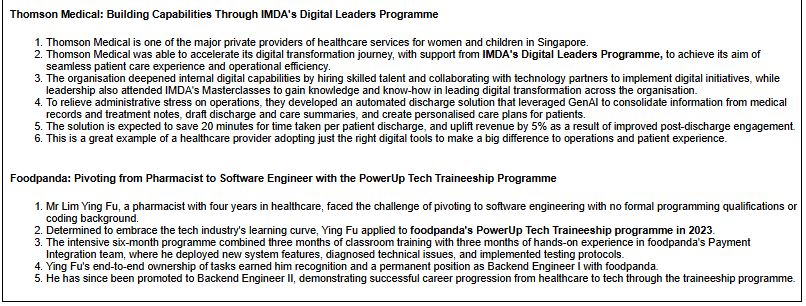
Factsheet: Company Profiles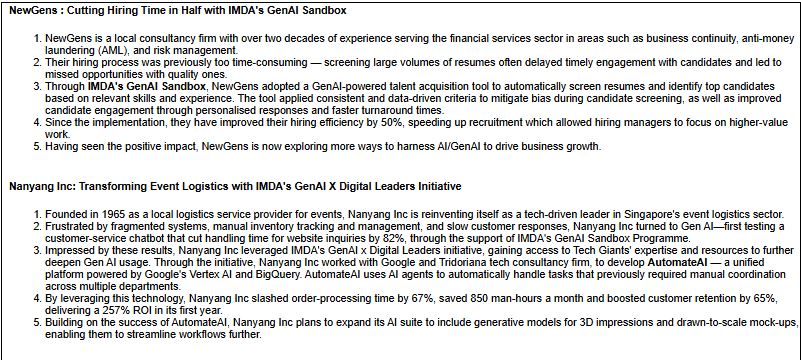
(ADVERTORIAL DISCLAIMER: The above press release has been provided by PRNewswire. ANI will not be responsible in any way for the content of the same.)
Get the App