 हिंदी खबर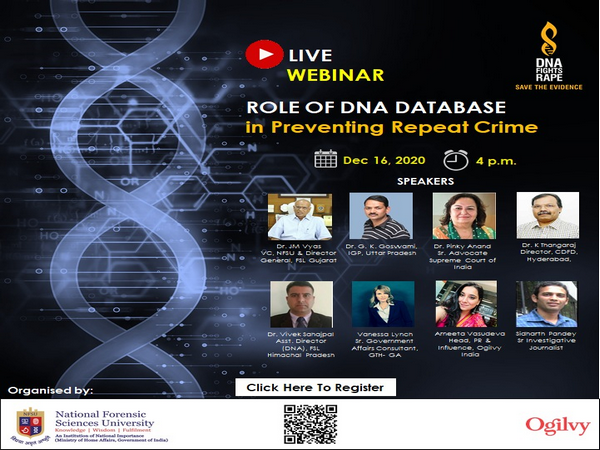

Gandhinagar (Gujarat) [India], December 16 (ANI/BusinessWire India): Led by Dr JM Vyas, Vice Chancellor, National Forensic Sciences University (NFSU) and Dr K Thangaraj, Director, Centre for DNA Fingerprinting & Diagnostics (CDFD), experts from the fields of forensics, biotechnology, law enforcement, criminal justice and policy came together to emphasise the importance of instituting a national DNA offender database in cracking down on violent sexual crime in India by taking repeat offender off the streets.
While agreeing on the effectiveness of DNA technology in reducing crime rate, the panel discussed contrasting themes of "value" versus "privacy" and how decision makers need to delicately balance these two competing imperatives to ensure that the balance maintained between the rights of the individual and the broader interests of society in tackling crime.
"The DNA Bill pending before Parliament for approval provides procedure and monitoring of DNA data bank of accused, unknown deceased, suspect persons as well as crime scene profiles. This will help to establish the identity of perpetrators of heinous crimes like rape, murder, disputed paternity, among others. At the same time, this bill will also help exonerate innocents from prosecution," said Dr JM Vyas, Vice Chancellor, NFSU & Director General, FSL Gujarat.
"DNA databases help in establishing the link between previous cases and present unsolved cases. They are effective in solving investigations because majority of crimes are committed by repeat offenders and criminals. It would be very useful in tracing multiple/repeated offenders, wherever they are. Establishment of an effective DNA database requires time and full cooperation between forensic laboratories, law enforcement agencies, and policymakers. Although several countries have established their DNA database, it is still at its infant stage in India. Public has mixed opinions on the subject and as responsible citizens we need to clarify their doubts and address all concerns," said Dr K Thangaraj, Director, Centre for DNA Fingerprinting & Diagnostics CDFD.
"DNA made a grand entry in a spectacular fashion into the courtroom in 1986 and globally proved its evidentiary worth as 'gold evidence'. Since inception, DNA not only enabled the judicial system to prove guilt beyond reasonable doubt, but also established innocence against wrongful accusation. India warmly adopted this 'genetic witness' both for adjudication in bodily crimes and in civil disputes, particularly in cases of parentage determination," said Dr GK Goswami, Inspector General of Police, Uttar Pradesh & Former Joint Director CBI.
On a cautionary note, Dr Goswami added that forensic manipulations reported worldwide do cast doubts on the credibility of scientific inputs, and indeed necessitate attention particularly towards developing robust mechanism to maintain the chain of custody of DNA samples. "Accreditation of laboratories and procedures, cognitive biases of actors at various levels, competence of experts are several intertwined areas which needs attention to maximise advantage of DNA strength in evidencing."
Drawing from her extensive experience in leading nationwide policy initiatives in Africa, Vanessa Lynch, Senior Government Affairs Consultant, GTH-GA pointed out that just like in India right now, in the lead up to the passing of the DNA Act in South Africa, lawmakers recognized that the uniquely private information which was revealed in a forensic DNA profile needed to be protected and provision for the protection of this information was entrenched in the legislation. "Since then, we have particularly seen violent sexual offenders linked to as many as 30 crimes from hits on the DNA Database. The retention and storage of forensic DNA profiles and in some instances, DNA samples, whilst raising some privacy concerns, is still considered to be important in the fight against crime, particularly against gender-based violence and femicide where there is little to no argument against the value of forensic DNA profiling to identify offenders," she added.
According to the Interpol, as many as 70 countries have a national DNA database, including the US, Canada, and China, holding more that 125 million offender samples. India, however, is counted among countries that use DNA profiling in criminal investigations, but do not store DNA information in a centralised database. According to studies, detection of crime in the UK went up from 26 per cent to a healthy 40 per cent after DNA samples were loaded into the national DNA database.
In the absence of a database, the estimated number of DNA profiles developed from crime scene evidence in India has grown from 10,000 cases tested in 2017 to nearly 20,000 in 2019. However, considering that India reports over half a million violent crimes every year, the volume of testing remains extremely low, especially in crimes against women and children.
"Despite economic progress, India continues to grapple with rising crime, poor conviction rates, and unprecedented backlog of court cases. India's law machinery still relies largely on outdated and unscientific methods of criminal investigation. Among violent crimes, sexual violence against women & children remains a burning issue. While reports of brutal rapes fill the news everyday with one incident every 15 minutes, only one in four reported rape cases result in conviction! This is because only a fraction of investigations is backed by forensic DNA technology. What started as the #DNAFightsRape citizen awareness drive has today become a movement with members of the civil society stepping forward to express the message of Don't Wash, Don't Clean. Save the Evidence in their own unique ways. We will continue to build the momentum to take this message to the masses till conducting DNA tests in rape cases becomes a norm," said Arneeta Vasudeva, Head, Public Relations, Ogilvy India.
The webinar titled 'Role of DNA Database in Preventing Repeat Crime' brought together subject matter experts, academics, and practitioners from across the spectrum of the Indian criminal justice system and scientific community, with the objective of sparking a healthy debate around the need for advanced forensic technologies like DNA and informing the public with their points of view.
The programme was presided by Dr JM Vyas, (VC, NFSU & DG, FSL Gujarat) constituted an eminent panel of experts including Dr K Thangaraj (Director, CDFD); Dr GK Goswami (IGP, Uttar Pradesh and Former Jt. Director, CBI); Dr Pinky Anand (Sr Adv. Supreme Court of India); Dr Vivek Sahajpal (Assistant Director-DNA, State FSL Himachal Pradesh); Vanessa Lynch (Senior Government Affairs Consultant, GTH-GA); and Arneeta Vasudeva, Sr VP & Capability Head, PR & Influence, Ogilvy India. The session was effectively moderated by Sidharth Pandey (Senior Investigative Journalist).
This story is provided by BusinessWire India. ANI will not be responsible in any way for the content of this article. (ANI/BusinessWire India)


