 हिंदी खबर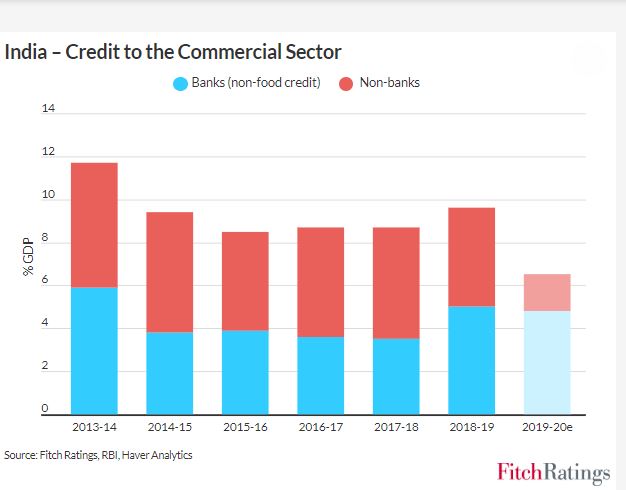

London [Britain], Oct 25 (ANI): The Indian economy is being held back by a large squeeze in credit availability emanating from non-bank financial companies (NBFCs), according to Fitch Ratings.
Assuming the sluggish pace of lending is maintained throughout the year, total new lending will amount to only 6.6 per cent of GDP in the fiscal year 2019-2020, down from 9.5 per cent in the previous fiscal year.
The Indian economy decelerated for the fifth consecutive quarter in Q2 FY20 with GDP expanding by a meagre 5 per cent year-on-year, down from 8 per cent recorded a year earlier.
This is the lowest growth out-turn since 2013. Weakness has been fairly broad-based, with both domestic spending and external demand losing momentum.
While an array of factors have contributed to the slowdown -- including a downturn in world trade -- Fitch believes that the severe credit squeeze has taken a heavy toll. NBFCs have faced a severe tightening of funding conditions over the past year-and-a-half.
"They have in turn sharply reduced the supply of credit to the commercial sector. The auto and real estate sectors have been particularly hit by NBFC credit rationing," said Fitch.
Data from the Reserve Bank of India (RBI) shows that the flow of new lending from non-bank sources was down 60 per cent year-on-year between April and September.
In contrast, banks' lending has held up well in recent months, mitigating some of the overall credit supply shortfall. However, bank lending could not prevent a sizeable credit crunch in the first half of 2019.
Fitch said the success of the inflation-targeting framework adopted by the RBI in 2016 in reducing inflation has been associated with sharply rising real lending interest rates since mid-2018. While the RBI has been able to lower interest rates, policy rate cuts have not been fully passed through to new rupee loans.
As a result, inflation-adjusted (real) borrowing costs have increased, weighing on credit demand.
The lack of monetary policy transmission in India derives from the combination of high public-sponsored deposit rates against a backdrop of stretched banks' balance sheets.
Competition from public schemes, which offer more attractive deposit rates to customers, has made banks reluctant to cut deposit rates. Banks have maintained elevated lending rates to preserve their margins amid high funding costs.
Fitch said Indian authorities have taken a string of policy measures over the past couple of months to shore up the economy and revive credit. For example, they are trying to ease NBFCs' liquidity positions by encouraging banks to purchase high-quality NBFC assets through credit guarantees and additional liquidity.
The government also proceeded with further capital injections into banks and has recently unveiled a plan to cut corporate tax. These measures should gradually improve the flows of credit and nudge up growth. Looser global financial conditions are also supportive, with a noticeable pickup in external commercial borrowings in 2019.
"We expect economic growth to be 5.5 per cent in 2019-20, before picking up to 6.2 per cent in 2020-21 and 6.7 per cent in 2021-22. Nevertheless, growth is likely to significantly below its potential over the next year or so," said Fitch.
(ANI)
India's credit squeeze pushes growth to a six-year low: Fitch Ratings
ANI | Updated: Oct 25, 2019 11:51 IST


