Indian economy continues to stand out for its exceptional resilience, remains stable against external headwinds: DEA Secretary
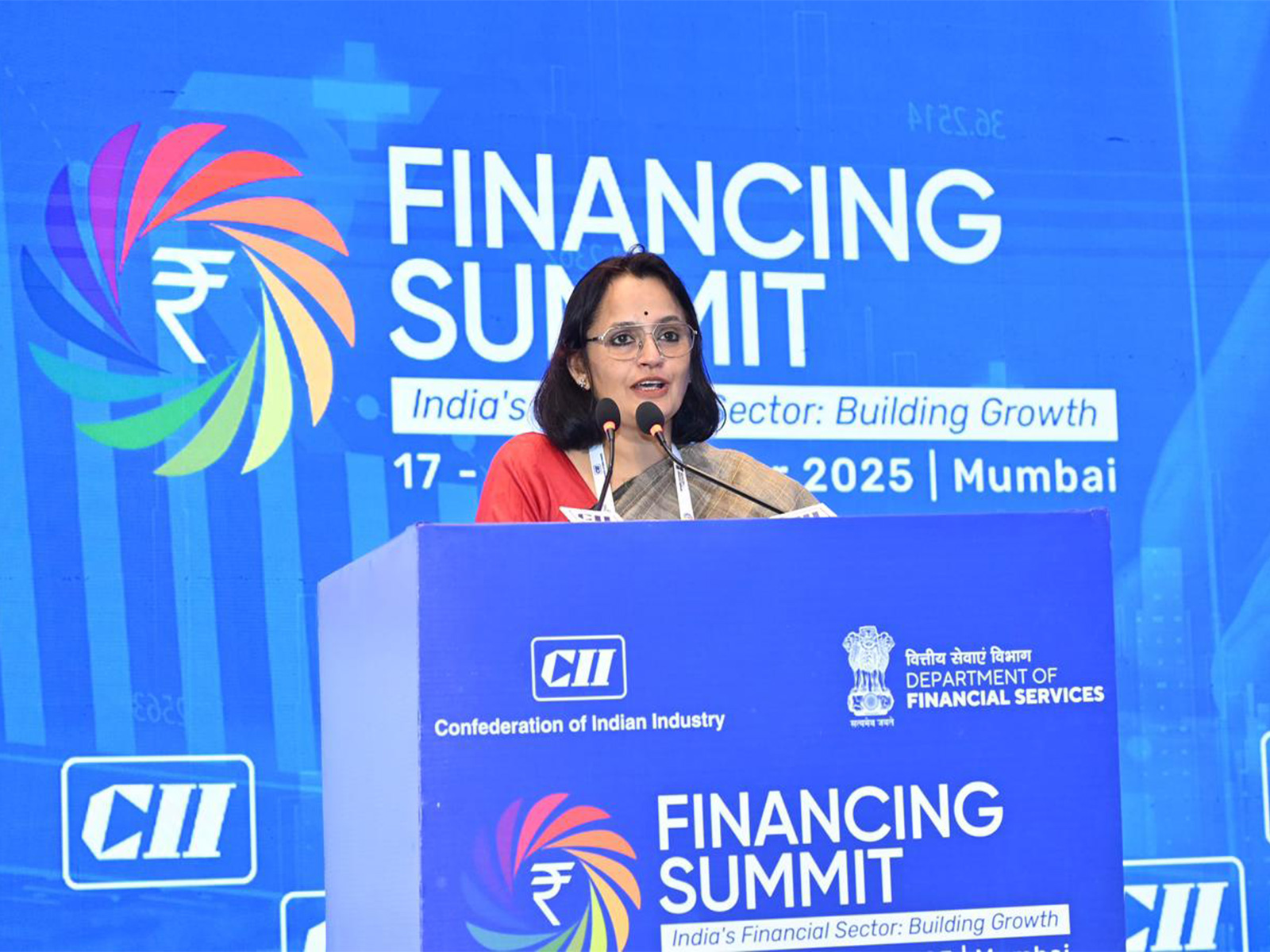
Amid heightened global uncertainty driven by disruptive tariff measures and escalating geopolitical tensions, the Indian economy continues to stand out for its exceptional resilience and remains firm and stable against external headwinds. Central to this resilience is the country's financial sector, which by channelling investment, is poised to serve as a catalyst for India's next phase of economic transformation as India advances toward a high-growth trajectory, highlighted by Anuradha Thakur, Secretary, Department of Economic Affairs, Ministry of Finance, during the opening plenary session on "Financing Future Growth" at the CII Financing Summit 2025 held in Mumbai on Monday.
ANI
Nov 17, 2025 20:14 IST

Mumbai (Maharashtra) [India], November 17 (ANI): Amid heightened global uncertainty driven by disruptive tariff measures and escalating geopolitical tensions, the Indian economy continues to stand out for its exceptional resilience and remains firm and stable against external headwinds.
Central to this resilience is the country's financial sector, which by channelling investment, is poised to serve as a catalyst for India's next phase of economic transformation as India advances toward a high-growth trajectory, highlighted by Anuradha Thakur, Secretary, Department of Economic Affairs, Ministry of Finance, during the opening plenary session on "Financing Future Growth" at the CII Financing Summit 2025 held on Monday.
According to a statement from CII, the Secretary was quoted as saying that India's financial sector has become sufficiently robust, innovative, and increasingly inclusive, and is now ready to script a new chapter of economic transformation.
She pointed out that the government has undertaken a plethora of measures such as recapitalisation of banks, strengthening NPA recovery mechanisms, to position the sector as the most stable among emerging economies.
However, given the rapidly evolving landscape, she emphasised the need for continued reforms and sustained focus on areas such as prudent regulation, disclosure and governance standards, gradual and controlled liberalisation, a strong and resilient banking system, deeper financial inclusion, a calibrated approach to foreign currency exposure, a world class payments and digital infrastructure and diversified financial infrastructure and strong macroeconomic management.
Secretary, Department of Economic Affairs also highlighted three major structural shifts shaping India's financial system: the rapid financialisation of savings, with mutual fund AUM tripling even as low-cost deposits slow; a shift away from bank-dominated credit, with banks' share in total credit falling from 77% in 2011 to around 60% in FY22; and a sharp rise in equity market participation, reflected in a six-fold increase in IPO activity since 2013. These trends, she noted, reinforce the need for deeper market liquidity and stronger regulatory coordination to channel savings into productive investment.
She also noted that several global investor's view GIFT City not just as a financial hub, but as a potential sandbox for wider financial-sector reforms in India.
She highlighted that ongoing work by IFSCA which is ranging from more facilitative fund management rules to deeper use of digital technologies and clearer regulatory frameworks which has positioned GIFT City to pilot innovations that can later be scaled across the broader financial system.
Expressing similar sentiments, V Anantha Nageswaran, Chief Economic Advisor to Government of India observed that globalisation is being reshaped by geopolitical realignments.
Capital flows, traditionally driven by market signals and macro fundamentals, are now increasingly influenced by political alignments and strategic considerations. This, he explained, gives rise to a paradox as despite India being one of the fastest growing economies, foreign investors continue to demand a higher country risk premium from India than from its developing country peers.
In this environment of politically driven global capital, Nageswaran stressed that India must prioritise domestically driven financing, as external capital alone will be insufficient to meet the scale of the country's development ambitions.
As per the statement, he also cautioned against trends visible in advanced economies, such as deepening financialisation, rapidly rising asset prices, and weak employment and warned of the potential bursting of the AI-driven boom, which he suggested could have far greater implications than the dot-com bust of the 2000s.
He also warned that rapid tokenisation and digital disintermediation will fundamentally reshape banking, urging financial institutions to stay aligned with the real economy and adopt a long-horizon approach.
Underscoring that stability, resilience and alignment with national priorities must anchor the financial system, Nageswaran said that domestic drivers must be strengthened across at least four high priority areas -- industrial upgrading and move towards high value-added production, harnessing the demographic dividend, near energy self-sufficiency, and deepening innovative capability.
Meeting these objectives, he noted, places a greater responsibility on the financial sector than on any other segment of the economy. He added that innovation in financial products must accelerate, especially in areas such as blended finance for climate goals, robust urban infrastructure financing models, and digital-first insurance. (ANI)
Tags:
Get the App