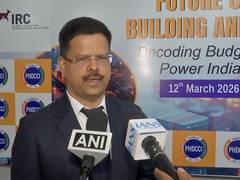
India needs Digital Twin Policy to drive 33 pc increase in infra investment, achieve 40 USD trillion economy by 2047: Study
India's infrastructure sector is on the brink of a major transformation. As the nation sets its sights on becoming a USD 40 trillion economy by 2047, the role of advanced technologies in managing and expanding infrastructure projects assumes vital importance
ANI
Jul 15, 2024 22:09 IST


New Delhi [India], July 15 (ANI): India's infrastructure sector is on the brink of a major transformation. As the nation sets its sights on becoming a USD 40 trillion economy by 2047, the role of advanced technologies in managing and expanding infrastructure projects assumes vital importance.
GeoSpatial World, a leading think tank in the field of space, geospatial, and digital twin technologies, has unveiled a pivotal study revealing the urgent need for a National Digital Twin Policy that would not only augment ongoing deep tech strategies like space, geospatial, AI, and Deep Sea Mission, but would also amplify their collective impact towards productivity gains and through sustainable and resilient Indian infrastructure.
A study, undertaken by Geospatial World and TechKnowMics under the aegis of the Think Tank on Digital Twin Strategy for Indian Infrastructure, highlights that a National Digital Twin Policy could provide the strategic technology integration and data-centric approach needed across the entire lifecycle of Indian infrastructure to achieve these lofty ambitions.
According to a press release, the policy framework will be a game-changer for the country's infrastructure development, aligning with India's Vision 2047 goals and addressing both current and future challenges, the release said.
This policy would leverage Digital Twin technology--a real-time digital modeling of physical assets, processes, and systems--integrating advanced tools such as Geographic Information Systems (GIS), Building Information Modeling (BIM), Artificial Intelligence (AI), and the Internet of Things (IoT).
Sanjay Kumar, CEO of Geospatial World, said that in the face of monumental infrastructure demands, a National Digital Twin Policy is not just a vision but a necessity.
"Our study reveals that Digital Twin technology can significantly enhance the planning, execution, and maintenance of infrastructure projects, advancing the vision of the Prime Minister towards 'Coalition for Disaster Resilient Infrastructure (CDRI)' positioning India at the forefront of global infrastructure innovation".
Kamal Kishore, assistant Secretary General of UN Office on Disaster Risk Reduction, said in report that delivering infrastructure resilient to natural hazards is fundamental to continued economic growth, prosperity, and sustainable human development.
While the idea of resilient infrastructure is simple, its overall execution requires a dynamic approach through the use of modern and disruptive technologies such as geospatial, BIM and in particular, Digital Twin, as it provides a vast platform for the integration of modern technologies and contributes at every stage of infrastructure building, such as planning, building, operations, and maintenance.
The study outlines the value proposition of using Digital Twins in Indian infrastructure projects to provide comprehensive and actionable insights for early warning, prompt response, improved public safety, and reduction in damage to infrastructure, ensuring long-term sustainability.
In 2023, India's infrastructure market was valued at Rs 15.47 lakh crore, a testament to the sector's rapid growth and its pivotal role in the country's economic development.
However, to meet future demands and sustain this growth, India will need to secure over Rs 374 lakh crore in investments by 2040.
The 2023-24 Union Budget reflects a strong commitment to infrastructure, with Rs 10 lakh crore allocated--a 33 per cent increase from the previous year, representing 3.3 per cent of the nation's GDP.
The report notes that despite these substantial investments, there are significant gaps and challenges that need addressing.
"The potential of Digital Twin technology to transform infrastructure management cannot be overstated. By providing detailed simulations and real-time data, Digital Twins offer a pathway to not only overcome existing challenges but also to proactively shape the future of India's infrastructure sector," Kumar said.
The study highlights how Digital Twin technology addresses several key challenges facing the infrastructure sector today.
For instance, there is a pressing need to bridge gaps in transportation and utility services, manage funding constraints, and overcome a shortage of skilled professionals in engineering and construction.
According to Amit Ghosh, Additional Secretary, Ministry of Social Justice, departing from earlier approach of need-based and siloed infrastructure planning, stakeholders need to advocate and implement a long-term integrated infrastructure development strategy to manage the multi-dimensional Infrastructure vision of the country effectively.
To maximize the value of the capital investment, integrated infrastructure is critical and Prime Minister GatiShakti National Master Plan is one of these path-breaking initiatives of the Government of India.
Ananya Narain, VP Consulting, said the policy will tackle complex regulatory frameworks and land acquisition issues, while also addressing the challenge of integrating new technologies and ensuring equitable access.
"In fact, Digital Twin Policy will provide a platform to utilise and harness the benefits of strategic initiatives being undertaken by the Indian government in the fields of space, geospatial, AI, deep sea, and drones. Most of these initiatives would create plethora of data through a range of innovative sensors in near real-time, and the digital twin policy would augment its holistic use for Indian infrastructure."
The study said that advantages of implementing a National Digital Twin Policy are multifaceted and Digital Twins offer a range of benefits across the infrastructure lifecycle.
During the planning and design phases, these technologies enable precise site surveys and the creation of detailed 3D models.
For example, advanced tools such as UAV-based LIDAR and radar interferometry can generate high-resolution data, improving site selection and management with a potential 30 per cent improvement in energy efficiency and a 20 per cent reduction in project reworks, the report said.
In the construction phase, Digital Twin technologies streamline workflows and increase production output by 10 per cent, while also reducing asset management downtime by 30 per cent, it added.
The study said this efficiency extends into the operations and maintenance phases as well, where Digital Twins support ongoing asset management and risk mitigation through web-based GIS systems and advanced sensors.
According to study, sustainability is a major advantage of the National Digital Twin Policy. By simulating various scenarios, Digital Twins help improve energy efficiency, reduce waste, and promote environmentally friendly designs, it added. "For instance, by modeling energy consumption patterns, these technologies help identify opportunities for reducing carbon footprints in infrastructure projects, aligning with Vision 2047's environmental goals."
It said economic efficiency is another critical benefit of the Digital Twin Policy. The technology facilitates predictive analytics for early risk detection, optimizes resource use, and reduces project costs.
The ability to perform scenario simulations and risk assessments results in more effective decision-making and streamlined project execution, the study said, adding that the urban development geospatial market is expected to reach Rs 3,445 crore by 2025, reflecting the growing importance of GIS in infrastructure planning.
Advanced sensors and scanners, such as LiDAR and GPR, are crucial for terrain mapping and asset management, with the transport infrastructure sector's geospatial market projected to grow to Rs 2,470 crore by 2025.
The study said a National Digital Twin Policy will envision advanced applications of Digital Twin technology, including predictive analysis, lifecycle integration, and AI-driven performance optimization.
The policy's strategic goals will also include the establishment of industry-wide standards, fostering innovation, and promoting collaboration across the Digital Twin sector.
The study said introduction of a National Digital Twin Policy will mark a new era for India's infrastructure sector. "By embracing this technology, India can lead the way in innovative, efficient, and sustainable infrastructure development. This policy is not just about meeting future demands; it's about setting a new standard for excellence in infrastructure management," Kumar said. (ANI)
Get the App