India: Metro rail growth transforms urban mobility, improves household finances
India's metro rail network has witnessed rapid expansion over the past decade, emerging as a key pillar of urban infrastructure while delivering significant economic and social benefits, according to a recent government analysis highlighting the country's growing investment in modern mass transit systems.
ANI
Mar 15, 2026 16:14 IST

New Delhi [India], March 15 (ANI): India's metro rail network has witnessed rapid expansion over the past decade, emerging as a key pillar of urban infrastructure while delivering significant economic and social benefits, according to a recent government analysis highlighting the country's growing investment in modern mass transit systems.
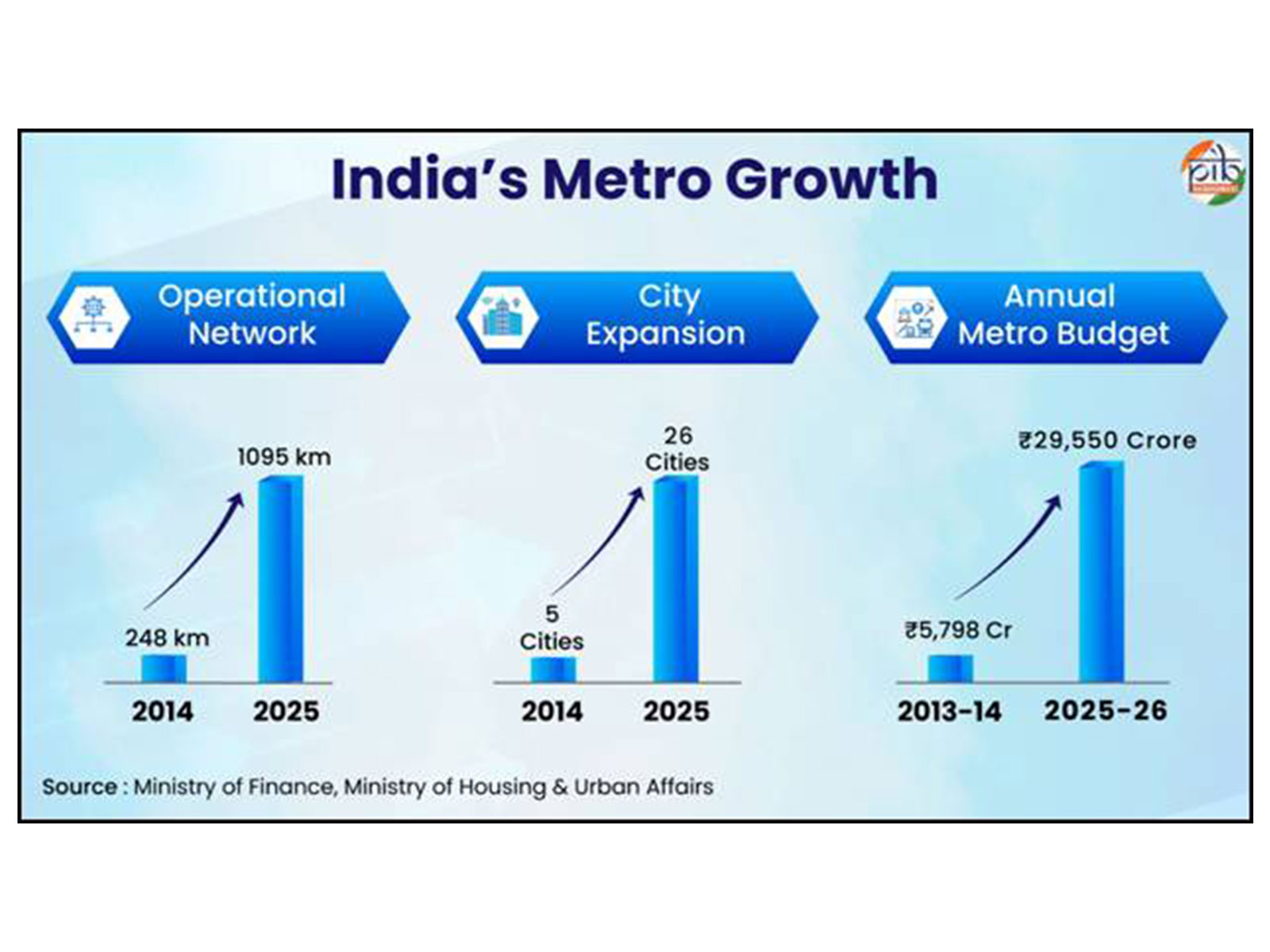
The country's operational metro network has expanded from 248 km in 2014 to about 1,095 km in 2025, reflecting a sharp acceleration in urban mobility infrastructure. Alongside the increase in track length, metro services have expanded geographically from just five cities in 2014 to 26 cities by 2025, bringing mass rapid transit to a much larger share of India's urban population.
The expansion has positioned India among the largest metro rail networks in the world, with systems now operating across major metropolitan centres including Delhi-NCR, Mumbai, Bengaluru, Kolkata, Hyderabad, Chennai, Lucknow, Pune and Ahmedabad. The rapid rollout has transformed commuting patterns by offering faster, more reliable and environmentally sustainable transport alternatives in densely populated cities.
Government spending on metro infrastructure has also increased substantially over the same period. The annual metro budget has risen from Rs 5,798 crore in 2013-14 to Rs 29,550 crore in 2025-26, reflecting more than a five-fold increase in financial allocations to expand and modernise urban transit systems.
The rising investment aligns with broader infrastructure initiatives aimed at improving connectivity, supporting economic growth and enhancing quality of life in rapidly urbanising regions. Metro systems are increasingly being integrated with national infrastructure planning frameworks such as the PM GatiShakti National Master Plan to ensure better coordination with other transport networks and urban development strategies.
Beyond mobility improvements, a recent study by the Economic Advisory Council to the Prime Minister (EAC-PM) highlights the wider economic impact of metro connectivity on household finances. The study, titled 'Golden Decade of Infrastructure Development in India with Special Reference to Metro Rail Network', finds that improved metro access can significantly strengthen household financial stability.
According to the analysis, households living in metro-connected areas tend to demonstrate better loan repayment discipline and lower financial stress, primarily due to reduced transport expenses and lower dependence on private vehicles. Lower commuting costs free up monthly income that can be used to service housing loans and other financial obligations.
City-level data presented in the study illustrate the trend. In Delhi, missed home-loan payments declined by 4.42 per cent, while early mortgage repayments increased by 1.38 per cent after metro connectivity improved. Similar trends were observed in Bengaluru, where repayment delays fell by 2.4 per cent and early repayments rose by 3.5 per cent. In Hyderabad, missed payments declined by 1.7 per cent, with early repayments increasing by 1.8 per cent.
The study attributes these outcomes to the reduced financial burden associated with daily commuting. By lowering spending on fuel, vehicle maintenance and travel time, metro networks allow households to manage their finances more effectively and reduce overall indebtedness.
Such benefits extend beyond individual households. Improved repayment behaviour can also strengthen the financial system by lowering credit risks for lenders while supporting broader economic resilience.
With more metro corridors under construction and additional projects planned across emerging urban centres, India's metro rail expansion is expected to play an increasingly central role in shaping sustainable urban mobility, boosting economic productivity and improving the financial well-being of urban households. (ANI)
Get the App