 हिंदी खबर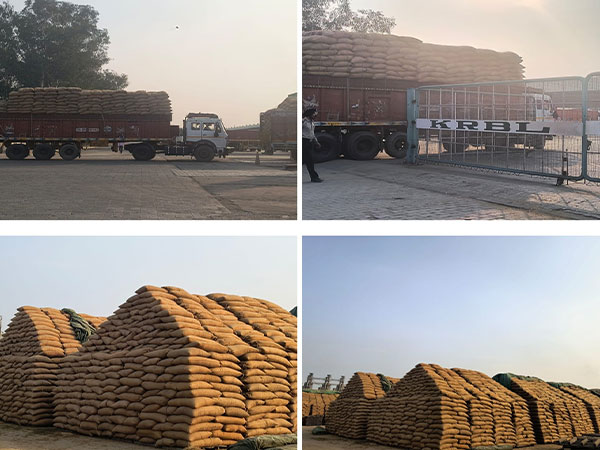

Dhuri (Punjab) [India], November 23 (ANI): The parent company of 'India Gate' basmati rice brand has set a record paddy procurement target this season, given the opportunities the business has to offer with the government removing the floor price on export of Basmati rice in September this year.
India consumes about 105-110 million tonne of rice annually, of which about 4 million tonne is Basmati. The country exports about 5 million tonne Basmati, worth around Rs 40,000-50,000 crore.
India is the leading exporter and grower of basmati rice in the global market, followed by neighbouring Pakistan. The government’s decision to remove the MEP (minimum export price) on Basmati rice is expected to enable Basmati rice-producing farmers to export and earn higher profits. It is said that the Pakistani exporters were benefitting earlier because they were able to trade at a lower cost, without barrier.
“We are looking at higher export as compared to last year,” said Kunal Gupta, Head Dhuri Plant, a fifth-generation businessman.
He said they are in the process of procuring about a million tonne of paddy from farmers from the recently harvested kharif Basmati paddy.
“This year we will be buying highest paddy because of the opportunities in both domestic and global markets. Because of the MEP removal, there’s a lot of demand. So we are forecasting a good year. Our procurement target is about a million tonne,” Kunal Gupta told reporters at their Dhuri facility.
India Gate parent company KRBL Ltd does milling itself for their brand. They do not mill rice for other private players or for the government.
KRBL sells about 7,00,000 tonne of basmati rice annually, and 30 per cent of it is exports, “which is growing”.
“As a company, we have decided that we will do only business which has double digit bottom-line (profits). We operate only in the premium segment,” Ayush Gupta, Head India Business, told the reporters, explaining the rationale behind milling rice.
Rice is a risky trade with a lot of volatility in prices, besides the short procurement window.
“We have been able to survive because we have created a brand. Brand safeguards you from volatility,” said Ayush Gupta.
The founders had in 1994 made a conscious decision to make a rice brand ‘India Gate’ at a time when agricultural commodities were mostly sold in loose unlabelled packs.
Basmati rice is a GI-tagged product.
KRBL is also foraying into other premium non-basmati rice categories. Some non-basmati rice varieties sell at a premium.
“We entered into non-basmati segment two years back. We have set up a plant in Gujarat and we are in the process of setting up a plant in Karnataka,” said Kunal Gupta.
Asked why there was a need for diversifying product offerings beyond basmati, he said India Gate brand will work in their favour.
Among other offerings they are focusing on is biriyani masala.
“It is already on e-commerce platforms for a year now. Now we are planning to launch it in brick-and-mortar general stores. Looking at the success of biriyani masala, we are actually creating a range of masalas, for premium market. We will launch it in the first quarter of next financial year. We will be in the spice mix category, because consumer convenience is a factor, he said.
“In 30 years, we have made such a strong brand. India Gate has become synonymous to a rice provider… Atta, spices, edible oils, and pulses are all logical extension that we see in the brand India Gate,” he added.
In the immediate term, Kunal Gupta said they are entering into edible oil business.
“It is a category where we can add value. In January, we are planning to launch it. We already produce unrefined rice bran oil at our plant, and it is a logical conclusion to process and retail it. Our retail network ecosystem in a way will complement it,” he said.
“These are two categories – spices and oil – we are looking at aggressively to launch it in the next few months,” he added.
Speaking of the challenges in procuring rice, Kunal Gupta said mechanized harvesting is reducing the harvest window -- it has shrunk from 90 days to about 45-60 days.
He said labour, machinery, infrastructure, transportation during harvest all get overburdened.
“Procuring in volume is a challenge. Because every process is time-sensitive,” he said.
KRBL has an annual installed capacity to process about 1.2 million rice cumulatively across its six plants. At present, they only process 0.6-0.7 million tonne, of which 30 per cent is exports.
Its plant in Punjab’s Sangrur’s Dhuri, spanning over massive 200 acres, is the world’s largest integrated rice processing facility. Founded in 1889, KRBL Ltd is a listed company headquartered in Noida.
KRBL had some issue with distribution channel in the middle east in the recent past and it has been looking out for other potential countries for exports.
“We are gaining back share in middle east and at the same time we are eyeing increasing distribution channels in Europe, Australia, Canada, among others,” Kunal Gupta said.
In August 2023, a floor price of USD 1,200 per tonne was imposed on basmati rice exports as a temporary measure. The decision was in response to a tight domestic supply and rising rice prices in the domestic market. It was also aimed at preventing the misclassification of non-basmati rice as basmati during exports.
However, following representations from trade bodies and stakeholders, the government reduced the floor price to USD 950 per tonne in October 2023. In mid-September this year, the government removed the cap on exports, besides easing trade barriers other varieties of rice.
Asked what policy intervention may be needed for the rice business, Kunal Gupta said the government and the food safety regulators must augment the quality control standards, given many importing countries do stringent checks for pesticide residues for incoming shipments.
He said as part of self-regulation, KRBL is setting up an in-house pesticide residue testing lab and it is expected to be operational in early next year. (ANI)


