India aims to become world's cheapest producer of green hydrogen by 2030: Former Niti Aayog CEO
India is positioning itself to become the world's cheapest producer of green hydrogen, targeting a drastic cost reduction from USD 4.5 per kg to USD 1 per kg by 2030, India's G20 Sherpa and former Niti Aayog CEO Amitabh Kant said on Wednesday.
ANI
Nov 26, 2025 21:43 IST

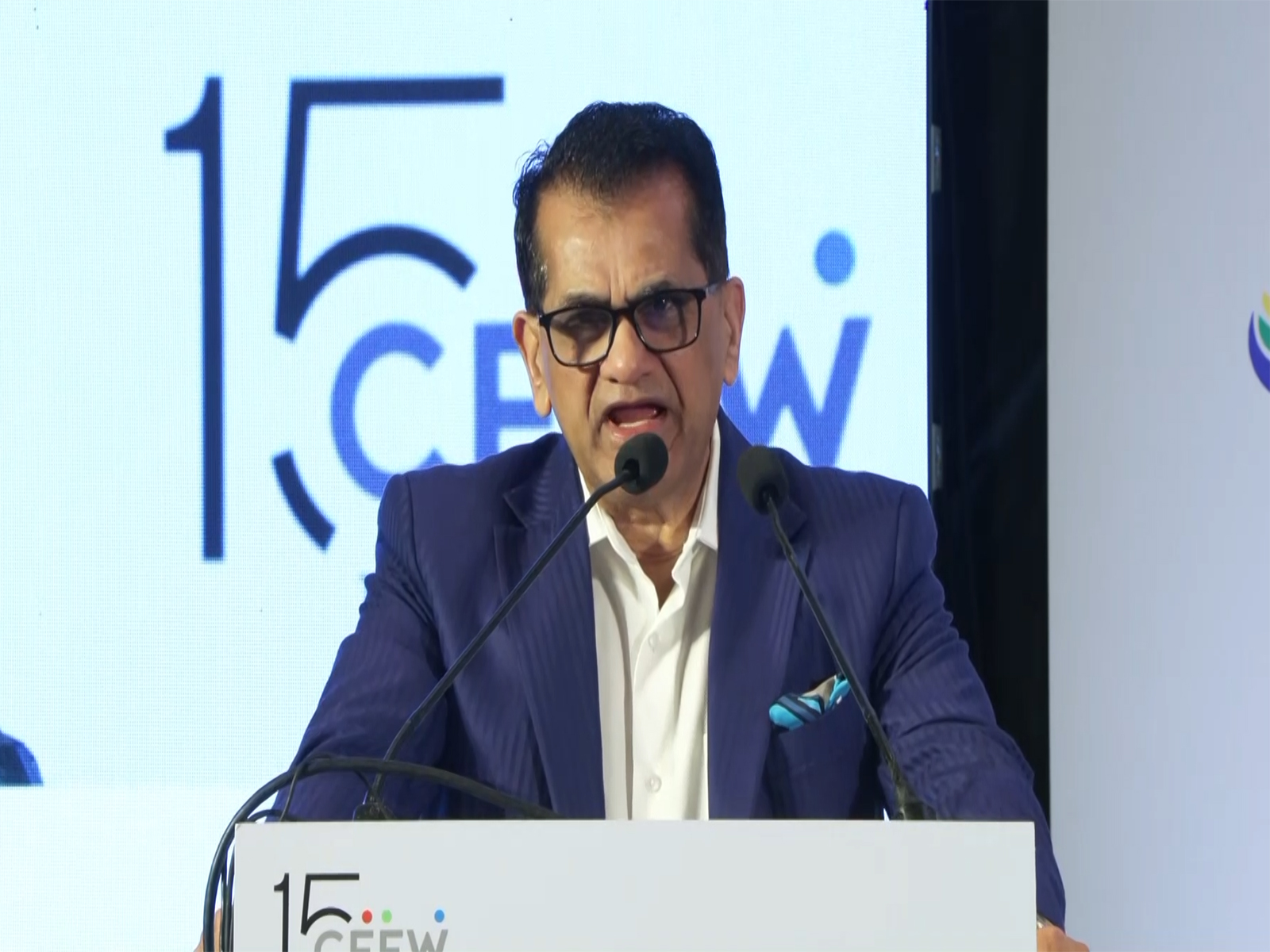
New Delhi [India], November 26 (ANI): India is positioning itself to become the world's cheapest producer of green hydrogen, targeting a drastic cost reduction from USD 4.5 per kg to USD 1 per kg by 2030, former Niti Aayog CEO Amitabh Kant said on Wednesday.
Speaking at the National Green Economy Conclave, organised by Council on Energy, Environment and Water (CEEW), Kant said the move towards the low-cost green hydrogen is set to reshape industries such as steel, fertilisers, mobility and heavy transport. "If we crack the USD 1 per kg milestone, India will become the world's green energy powerhouse."
"The National Green Hydrogen Mission, rapid expansion of solar capacity, and declining renewable tariffs are all converging to make this ambition feasible," he said. He further called it as a "defining pillar" of the country's long-term growth strategy.
"Green hydrogen is not just an energy alternative, it is India's gateway to global leadership in clean manufacturing and deep decarbonisation," Kant said, emphasising that India's renewable energy ecosystem gives it a competitive edge unmatched by most economies.
He added that the shift will open new space for India's entrepreneurs. "Circular economy will unlock massive opportunities for startups," Kant said.
"Young innovators must drive new R&D, new materials, recycling technologies and disruptive solutions for the green economy."
He stressed that India's innovation ecosystem, backed by digital infrastructure, geospatial tools and AI, will play a critical role in accelerating the green transition.
At the macroeconomic level, Kant highlighted that the transition could be transformative. India's green shift, he said, is projected to create 48 million jobs, attract USD 4 trillion in investments, and unlock a USD 1.4 trillion market, as estimated in a report by CEEW.
"This is not a marginal reform--it is a massive new economic opportunity for India's youth," he said, calling it the country's biggest development opening since the 1991 reforms.
He also underscored that India must avoid copying the Western model of fossil-fuel-heavy growth. "The Western world built cities for cars, not for people. India must not replicate that model," Kant said. He added that circularity, bioeconomy and green urban design must form the backbone of India's growth pathway if it wants to lead in sustainable development.
A key structural advantage for India, he said, is the country's stage of development. Half of India is yet to be built, and nearly 500 million people will urbanise in the coming decades. "No other major economy has this scale of future construction. This is our once-in-history chance to build cities that are green, inclusive and designed around public transport," he noted.
Kant said India's growth model must integrate sustainability across sectors--from infrastructure and mobility to energy and manufacturing. "If we get this right, India will not only grow fast but grow responsibly, setting a benchmark for the world," he concluded.
Jayant Sinha, President, Everstone Group & Eversource Capital, and Former Union Minister of State, addressing the event through video conferencing, said, "India's green transition is fundamentally net positive: it can create millions of jobs, accelerate growth, improve public health and strengthen national security by shifting to domestic energy sources."
Abhishek Jain, Director, Green Economy and Impact Innovations, CEEW, told ANI, "India today imports 87 per cent of its crude, which can be reduced to zero with electric vehicles, solar energy and next-generation bioethanol and biodiesel. We import 100 per cent of our lithium, nickel and cobalt, and even 93 per cent of copper ore--all of which can become zero-import with a circular economy."
"The country is heavily dependent on fertiliser imports--all of our potash is imported, and 88 per cent of urea is directly or indirectly import-dependent," he added.
The CEEW's Green Economy study maps 36 such opportunities across the energy transition, circular economy, bioeconomy, and nature-based solutions, estimating their jobs-market-investment potential for 2047, in line with India's Viksit Bharat vision. These include circular economy solutions such as lithium-ion battery recycling, e-waste and plastic recycling, and reusing used cooking oil; bioeconomy solutions. (ANI)
Tags:
Get the App