 हिंदी खबर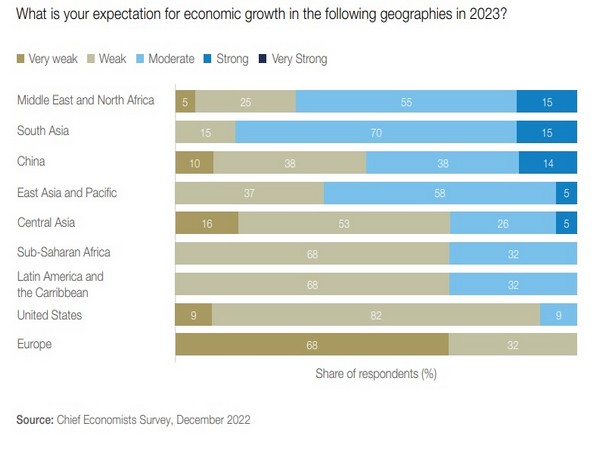

Davos-Klosters [Switzerland], January 16 (ANI): About two-thirds of private and public sector chief economists in a World Economic Forum survey have said a global recession is likely in 2023 with almost 18 per cent saying it is "extremely likely".
"Almost two-thirds of respondents consider a global recession to be likely in 2023, including 18 per cent who consider it extremely likely, more than twice as many as in the previous survey in September 2022," said 'The January 2023 Chief Economists Outlook' by the World Economic Forum's Centre for the New Economy and Society.
However, views are divergent, with a third of respondents considering a global recession to be unlikely this year.
The survey aims to summarise the emerging contours of the current economic environment and identify priorities for further action by policymakers and business leaders in response to the compounding shocks to the global economy from geo-economic and geopolitical events.
The survey was conducted November-December 2022.
Regionally, the situation in Europe and the US is now stark, with 100 per cent of chief economists expecting weak or very weak growth for 2023 in the former and 91 per cent in the latter, the survey said.
War and international tensions continue to shape global economic developments, and every respondent viewed it as likely, with 73 per cent saying somewhat and 27 per cent saying extremely, that patterns of economic activity will continue to shift around the world in line with new geopolitical fissures and faultlines.
The two strongest regions in 2023 according to the survey are the Middle East and North Africa (MENA) and South Asia.
In South Asia, 85 per cent of respondents expect moderate (70 per cent) or strong (15 per cent) growth, a modest improvement since the September edition. Some economies in the region, including Bangladesh and India, may benefit from global trends such as a diversification of manufacturing supply chains away from China.
Although no regions are slated for very high inflation, expectations of high inflation range from 57 per cent of respondents for Europe to just 5 per cent of respondents for China. Following a year of sharp and coordinated central bank tightening, the chief economists surveyed expect the monetary policy stance to remain constant in most of the world this year.
However, a majority of respondents expect further tightening in Europe and the US with 59 per cent and 55 per cent, respectively.
At the start of 2023, concerns about the cost of living remain acute in many countries. Yet, survey respondents indicate that the cost of living crisis may be close to its peak, with a majority (68 per cent) expecting the crisis to have become less severe by the end of 2023. A similar trend is evident in the energy crisis, with almost two-thirds of respondents optimistic that conditions will have begun to improve by the end of the year.
The survey also asked chief economists to highlight any sources of optimism in the current global economic context. Three factors were mentioned repeatedly: The strength of household balance sheets, the peaking of inflation and the resilience of labour markets.
The outlook for the global economy is gloomy, according to the results of the latest survey of chief economists. Global growth prospects remain anaemic, and global recession risk high.
Despite some positive signals in the final months of 2022 - an easing of inflationary pressures, a modest uptick in consumer sentiment and stabilisation of commodity prices - almost one in five respondents now consider a global recession to be extremely likely in 2023, more than twice as many as in the previous survey in September 2022.
However, 32 per cent also expect a global recession to be extremely unlikely or somewhat unlikely, more than twice as many as in September. This polarised outlook reflects a weakening of growth expectations across most but not all regions and significant continued uncertainty about the effectiveness and duration of tightening policy measures.
The survey also highlighted significant regional divergence in growth expectations within a general pattern of weakened expectations relative to the last survey. The situation in Europe and the US is now stark, with 100 per cent of chief economists expecting weak or very weak growth this year in the former and 91 per cent expecting weak or very weak growth in the latter. This marks a significant deterioration in recent months: at the time of the last survey, the corresponding figures were 86 per cent for Europe and 64 per cent for the US.
The survey results for the 2023 outlook in China are polarised, with almost half of the respondents now expecting weak or very weak growth in China, with the other half expecting moderate or even strong growth.
In MENA, 70 per cent of respondents expect moderate or strong growth in 2023. While this overall proportion has slightly dipped since the September edition, expectations of strong growth have increased from 12-15 per cent.
In the East Asia and Pacific region, 37 per cent of chief economists expect weak growth in 2023, and 63 per cent expect moderate or strong growth, similar to September. However, that broad pattern masks a shift in expectations from strong to moderate growth since the last survey. (ANI)
Global recession likely in 2023: World Economic Forum survey
ANI | Updated: Jan 16, 2023 23:43 IST


