Budget focuses on manufacturing to support currency stability, exports and strategic priorities: CEA Nageswaran
"Manufacturing matters for currency strength, for lower cost of capital, and also in today's world, manufacturing has taken on a strategic dimension," Nageswaran said while addressing the PHD Chamber of Commerce and Industry's (PHDCCI) post-Budget session.
ANI
Feb 04, 2026 18:05 IST

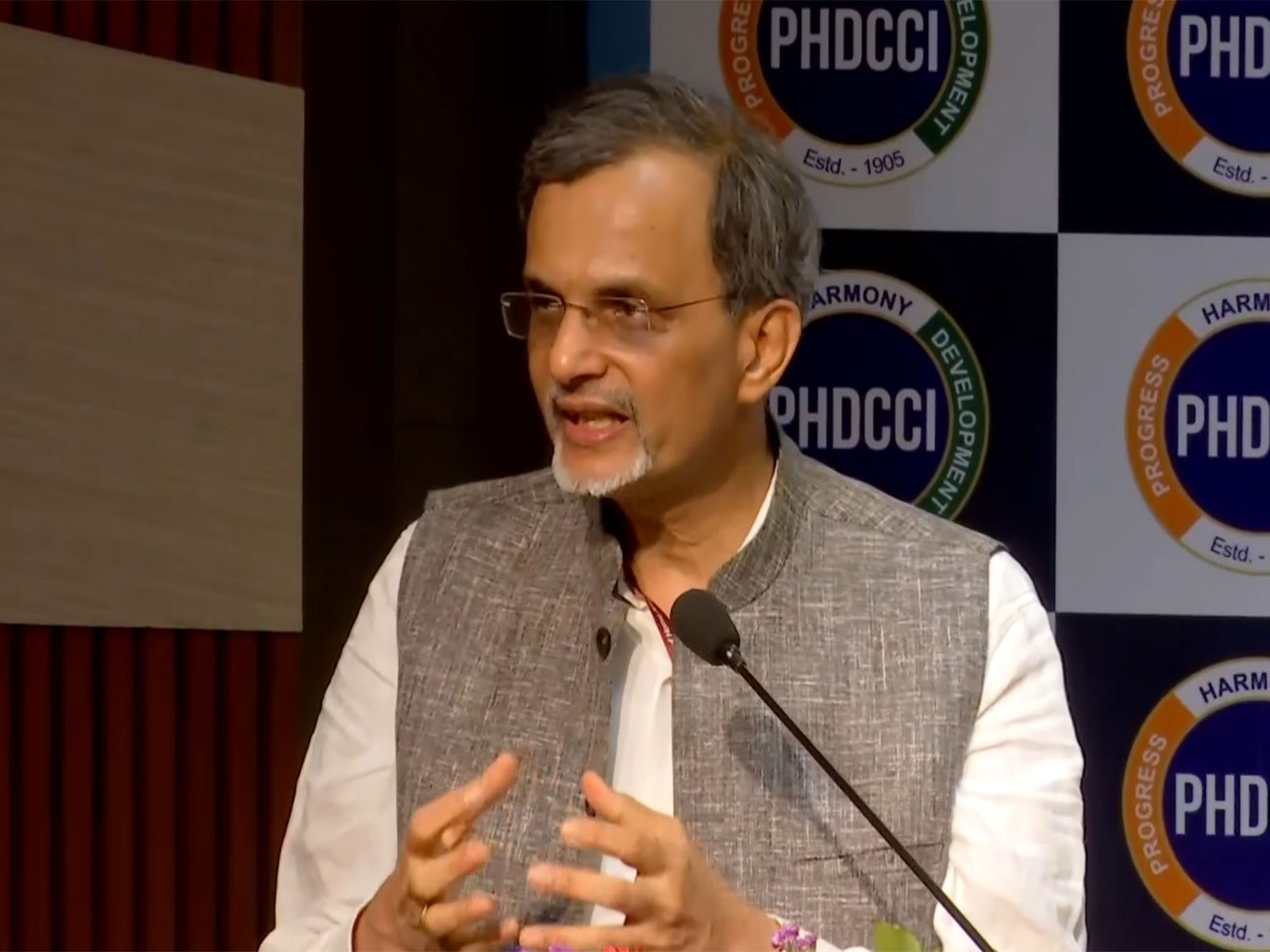
New Delhi [India], February 4 (ANI): Chief Economic Advisor (CEA) V Anantha Nageswaran on Wednesday highlighted that India's Union Budget places manufacturing at the centre of the country's economic and strategic priorities, as it is critical for currency stability, export competitiveness and strategic leverage in a fragmented global environment.
"Manufacturing matters for currency strength, for lower cost of capital, and also in today's world, manufacturing has taken on a strategic dimension," Nageswaran said while addressing the PHD Chamber of Commerce and Industry's (PHDCCI) post-Budget session.
On manufacturing, Nageswaran highlighted support for semiconductors under ISM 2.0, electronic component manufacturing, aircraft components, revival of old industrial clusters and labour-intensive manufacturing. He also pointed to a greater emphasis on domestic production of infrastructure equipment, chemicals and pharmaceuticals, including the biopharma mission.
"In the last two years, we have come to know that special infrastructure equipment shipments have been delayed," he said, adding that this had affected infrastructure schemes and reinforced the case for domestic manufacturing capacity.
To improve competitiveness, Nageswaran said input costs must be reduced. "For exports to be competitive, you need inputs to be competitive, which is where the customs duty exemptions are extremely important," he said.
On the macroeconomic front, Nageswaran said fiscal consolidation has continued after the pandemic.
Nageswaran said the global environment has changed fundamentally, reducing the reliability of supply chains that supported growth over the past four decades. "Just-in-time inventory systems worked very well in a globalised world, but manufacturing has taken on a different dimension in the new world of geopolitical fragmentation," he said.
He added that exports play a key role in maintaining currency stability and strength. "Manufacturing matters. Exports matter for currency stability and strength, and also for strategic leverage," Nageswaran said, pointing out that countries may no longer be able to supply goods "in the most efficient manner and timeliness which we were used to in the past."
The CEA said the Economic Survey and the Budget were closely aligned in identifying these challenges and responding through policy. "This time the Economic Survey runs into nearly 700 pages, and I'm very gratified to see a lot of synergy between the Budget and the Economic Survey document," he said.
Nageswaran said the Budget should be seen as part of an ongoing reform process that has accelerated since early 2025, citing labour code announcements, liberalisation of foreign direct investment in insurance and nuclear energy, environmental clearances, direct tax relief, goods and services tax (GST) reforms and income tax process simplification.
He said the Budget also continues the government's sustained focus on micro, small and medium enterprises (MSMEs), particularly after the pandemic. Measures include credit guarantee programmes, revisions to MSME thresholds in 2020 and 2025, mandatory timely payments by large firms to suppliers, and support for the Trade Receivables Discounting System (TReDS).
The Budget has also announced an SME Champion Fund focused on manufacturing, along with a Corporate Mitra scheme to provide mentorship and hand-holding.
The fiscal deficit has been reduced from 9.2 per cent of GDP to 4.4 per cent and is budgeted at 4.3 per cent, while the debt-to-GDP ratio is projected to decline from 56.1 per cent to 55.6 per cent. Capital expenditure on infrastructure has been maintained at Rs 12.2 trillion.
"This kind of sustained non-inflationary growth with fiscal discipline and fiscal stability is what got us three credit rating upgrades last year," Nageswaran said,
He also said that a lower cost of capital would benefit medium and small enterprises.
"The budget recognises the environment in which we operate," he said. "Strategic resilience matters, and for that, manufacturing matters." (ANI)
Tags:
Get the App